Advances in understanding and applications of plasmonics has led to beginning of development of unconventional anti-reflective coatings (ARCs) in which absorbing layers are also used. Here, the reduction of reflectance originates not only from phase contrast and destructive interference like in multilayer ARCs, but also due to high extinction in coating material (hence, absorbing ARCs). Using plasmonic scattering by nanoparticles, the reflectivity could be reduced significantly [1]. Such structures could be far thinner than conventional multilayer ARCs. Amorphous diamond-like carbon (DLC) is an attractive material to use as matrix for Ag nanoparticles. This is primarily due to high hardness, chemical inertness, and low friction coefficient [2].
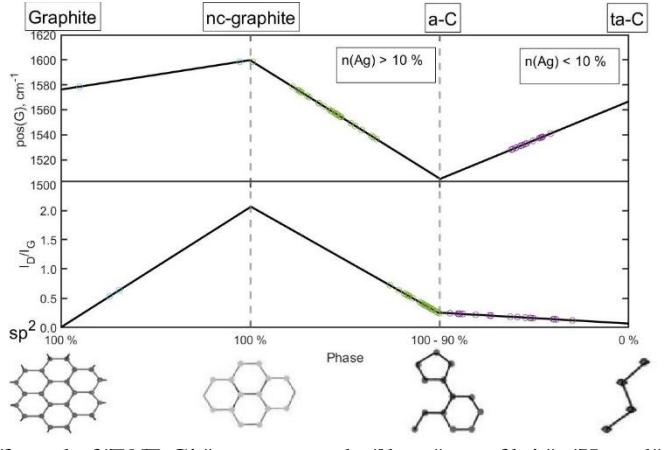
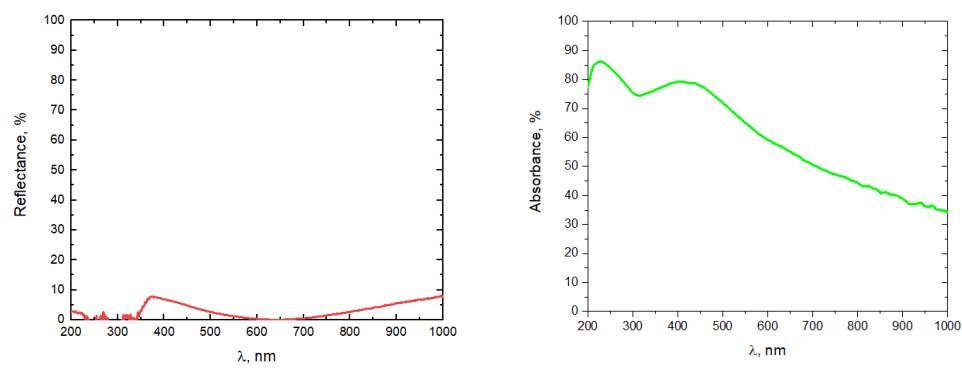
In the present work, we investigated a series of ultra-thin DLC:Ag films of thicknesses ranging from 50 to 300 nm and containing different amounts of silver. Nanocomposite films were deposited using custom build DC reactive magnetron sputtering system in acetylene gas atmosphere. Raman analysis, SEM, EDX, ablation threshold and UV-vis spectral characterizations were carried out. An important characteristic of DLC matrix is its sp3/sp2 bonding representing the diamond and graphite phase content in the films. As seen from Fig. 1. most samples fall into nc-graphite to a-C (amorphous carbon) or a-C to ta-C (tetrahedral a-C) category. Samples with low Ag content (< 10 at.%) show high sp3/sp2 bond ratio compared to samples with high Ag content (> 10 at.%). Fig. 2. Shows reflectance and absorbance spectra of DLC:Ag with 2.9 at.% Ag.