
During your conference registration you will be asked to submit an abstract. Your abstract will be strictly reviewed by the Programme Committee. If you have never written an abstract before, you are welcome to read the guide below (we present a condensed version of ‘How to Write an Abstract’ by Philip Koopman).
Since online search databases usually only display abstracts, it’s crucial to write a complete yet concise description of your work to attract readers to seek out the full paper. Abstracts have long served the purpose of “selling” your research, making them essential in capturing interest. Below, we provide key guidelines for writing an effective abstract, along with an example of a well-written one. With these tools, preparing a strong executive summary for the Open Readings conference should be more straightforward than ever.
1. Background
Start with 1-2 sentences that contextualize the research within the larger field. This should frame the study’s relevance or the problem it addresses. Avoid detailed literature reviews but reference key areas or gaps the research intends to address.
Clearly define the problem or challenge motivating the study. This should be accessible and avoid technical jargon as much as possible.
2. Objective
State the primary aim of the study or the research question it addresses. This section can also include the hypothesis if the study is hypothesis-driven. The objective should be direct and precise, summarizing what the study sets out to accomplish.
3. Methods
Provide a brief overview of the methodology or approach used in the study, keeping the description concise and clear. If the study involves experimental design, describe the main steps (e.g., sampling, measurements, analysis).
Specify any innovative techniques or tools utilized, if applicable, to underline the study’s novel approach.
4. Results
Summarize the primary findings, focusing on data or trends that directly support the study’s objectives. This section is typically the most specific and should include key quantitative or qualitative results without detailed statistical explanations.
For significant results, mention their potential implications or insights they provide. However, avoid over-interpreting these findings at this stage.
5. Conclusion
Conclude with a 1-2 sentence summary that reflects on the implications of the results. This might include suggestions for practical applications, recommendations for future research, or potential impacts on the field.
MODIFIED DIKETOPYRROLOPYRROLE EMITTERS FOR TUNABLE NIR-TO-VISIBLE PHOTON UPCONVERSION
Lukas Naimovičius1, Edvinas Radiunas1, Barbara Chatinovska2, Augustina Jozeliūnaitė2, Edvinas Orentas2, Karolis Kazlauskas1
1 Institute of Photonics and Nanotechnology, Vilnius University, Lithuania
2 Department of Organic Chemistry, Vilnius University, Lithuania
[email protected]
1) Triplet-triplet annihilation (TTA) mediated NIR-to-visible photon upconversion (UC) attained under incoherent and low power excitation is a rapidly advancing field of photonics with promising applications in photocatalysis, bio-imaging, photovoltaics, targeted drug delivery and night vision devices. [1-3] Generally, TTA-UC systems are comprised of a sensitizer and an emitter. The sensitizer is responsible for absorption of low energy photons and generation of triplet states via intersystem crossing, whereas the emitter accumulates those triplets and performs TTA resulting in upconverted emission of higher energy. Currently, there is a lack of efficient, stable, and tunable TTA emitters in the visible range preventing numerous possible applications. 2) In this work, the modified diketopyrrolopyrrole (DPP) compounds are proposed as the tunable and stable alternatives [4] to widely used rubrene and perylene diimide emitters.
3) Five DPP compounds (DPP-eh, DPP-c, DPP-s, DPP-Ph, DPP-2Ph) functionalized with different moieties were investigated as the emitters for NIR-to-visible UC. Palladium-phthalocyanine (PdPc) served as a sensitizer in this study. 4) Essentially, the DPP compounds exhibited high [latex]\Phi_{FL}[/latex] (64% – 74%) in the isolated form and a red shift of FL spectra with increasing the complexity of the moieties allowing to implement the tunable UC. DFT modelling was found to be in agreement with experiment and showed the same trend of singlet energy reduction. All DPP derivatives demonstrated the feasibility for TTA in a solution with moderate [latex]\Phi_{UC}[/latex] (0.4% – 2.3%) as compared to the widely used rubrene [latex](\Phi_{UC} = 5.6\%)[/latex]. While most of the derivatives exhibited UC threshold in the range of [latex]6 – 22\text{ W/cm}^2[/latex], the compound with large side moieties (DPP-2Ph) expressed a way higher threshold [latex](>100\text{ W/cm}^2)[/latex] making [latex]\Phi_{UC}[/latex] determination impossible. Furthermore, DPP compounds displayed significant aggregation in the solid state facilitating strong non-radiative decay and thus, complete inhibition of UC emission.
5) The obtained results suggest that the DPP derivatives can be considered as potential TTA emitters for solution-based applications in NIR-to-vis UC.
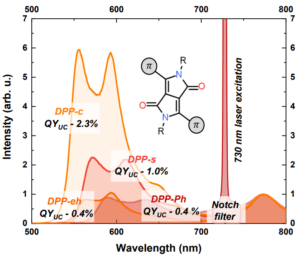
Fig. 1: UC emission spectra of DPP compounds in deoxygenated toluene solution. DPP and PdPc concentration, 8 mM and 30 𝜇𝑀, respectively. Φ𝑈𝐶, indicated.
[1] M. Wu et al., Nat. Photonics, vol. 10, no. 1. pp. 31-34, (2016).
[2] Radiunas, E. et al., J. Mater. Chem. C 8, 5525-5534 (2020).
[3] Fallon, K. J. et al., J. Am. Chem. Soc. 142, 19917-19925 (2020).
[4] Andrew B. Pun et al., J. Am. Chem. Soc., 141, 3777-3781 (2019).
FAQ:
The participant has to have completed the conference registration form, which will be evaluated by the conference programme committee. Each participant will be informed about the decision on participation/acceptance. During the conference, research must be presented at the venue as a poster/oral presentation during each participant’s scheduled session. In case the participant is not present during their assigned time slot, their abstract will not be published in the abstract book.
After submitting your registration form you will receive two evaluation emails. The first one will confirm whether or not your abstract meets the provided template. In the case of it not meeting the template, you are granted two weeks to make corrections and resubmit. After a successful template confirmation, your abstract is ready to be evaluated by the Programme Committee. The second email you receive will inform you about the decision on abstract acceptance. No further changes will be allowed to be made after the Programme Committee evaluation, regardless whether the abstract is accepted or rejected.
For your abstract and poster you should use IEEE citation style (instructions can be found here)
Open Readings does not provide a separate abstract template. Instead, you can register your abstract directly through our registration system. Simply fill in all the required fields, including the abstract field in LaTeX format. Once completed, click "Generate Abstract" and the system will automatically format your abstract, displaying it on the right side for review.