
Saccharomyces cerevisiae yeasts are single-celled eucaryotic fungus microorganisms. Since ancient times they have been used in baking, winemaking and brewing. They also have been widely used as a model organisms for a number of reasons including similar internal cell and gene structure to higher eukaryotes, fast doubling time and low maintenance requirements [1]. During the course of evolution yeast adapted to employ the HOG pathway to recover after dangerous cell shape modifications and intracellular water disbalance caused by environmental osmotic pressure changes [2]. Pulsed electric field (PEF) treatment is known to cause plasma membrane permeabilization, an effect known as electroporation, yet at the moment there is no information on whether biochemical pathways responsible for intracellular osmotic balance have a role in yeast response to PEF treatment [3].
In this study we investigated if osmotic pressure change has any effect on cell viability and whether HOG pathway plays a role in recovery after PEF treatment. Experiments were performed with wild type Y00000 yeast and a mutant strain derived from WT, Y02724, with no active HOG1 gene. Yeast from respective strains will be referred as WT and HOG. Cells were grown until 1 OD, transferred to electroporation buffer (20 mM TRIS, 1 M sorbitol, pH = 7.4), yeast suspension was exposed to single electric field pulse with duration of 150 µs and field strength of up to 10 kV/cm. Electroporation buffer was used as a reference point to represent isoosmotic conditions. After PEF treatment cells were immediately transferred to hyperosmotic (1.5 M sorbitol), isoosmotic or hypoosmotic (0.5 M sorbitol) solution, incubated for 5 minutes and plated on agaric YPD media. Swift osmotic pressure change will be defined as osmotic shock. After two days of incubation in 30 °C colonies were counted.
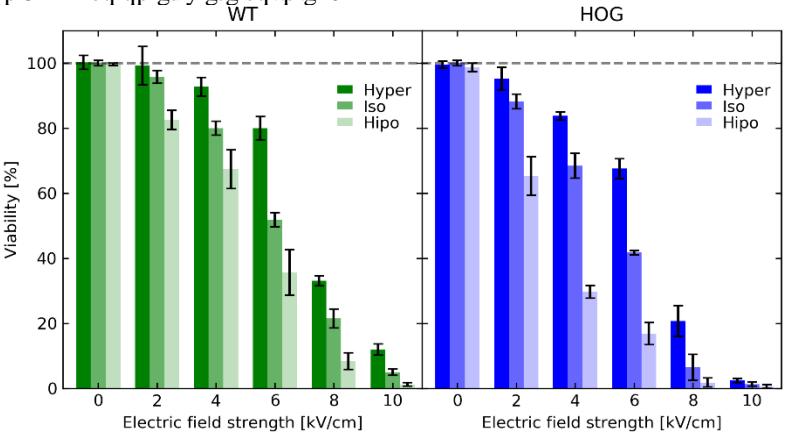
It was shown that cells' viability decreases with the increase of elecric field strength. Transfer of PEF treated cells to solutions with different osmotic composition significantly influenced yeast cell viability (Fig. 1.). Most notable viability changes were spotted after 4 and 6 kV/cm. After 4 kV/cm hyperosmotic shock increased WT and HOG viability by 13% and 15%, hypoosmotic – decreased by 12% and 39% respectively. After 6 kV/cm hyperosmotic shock increased WT and HOG cell viability by 28% and 26%, hypoosmotic – decreased by 16% and 25% respectively, relative to no (isoosmotic) shock treatment. To further investigate the influence of osmotic shock treatment leakage of intracellular compounds was evaluated. Absorbtion at wawelengths of 260 nm and 280 nm revealed that the amount of intracellular components in the media decreased after hiperosmotic shock and increased after hipoosmotic shock, supporting the hypothesis that mechanical cell shape alteration influences cells' reaction to PEF. Furthermore, statistical analysis confirmed that HOG strain was more sensitive to beforementioned treatments suggesting that HOG pathway is of relevance to recovery after electroporation.
To summarise, yeast cell viability after exposure to PEF can be altered by subsequent change in osmolarity of media. HOG pathway involvement was linked to recovery after electroporation.