DOES EXTENDING THE DONOR GROUP ENHANCE THERMALLY ACTIVATED DELAYED FLUORESCENCE PROPERTIES?
Eimantas Duda1, David Hall2, 3, Sergey Bagnich1, Cameron Carpenter-Warren2, Rishabh Saxena1, Michael Y. Wong2, David B. Cordes2, Alexandra M. Z. Slawin2, David Beljonne3, Yoann Olivier4, Eli Zysman-Colman2, Anna Köhler1
1 Soft Matter Optoelectronics, BIMF & BPI, University of Bayreuth, Germany
2 Organic Semiconductor Centre, EaStCHEM School of Chemistry, University of St Andrews, UK
3 Laboratory for Chemistry of Novel Materials, University of Mons, Belgium
4 Unité de Chimie Physique Théorique et Structurale & Laboratoire de Physique du Solide, Namur Institute of Structured Matter, Université de Namur, Belgium
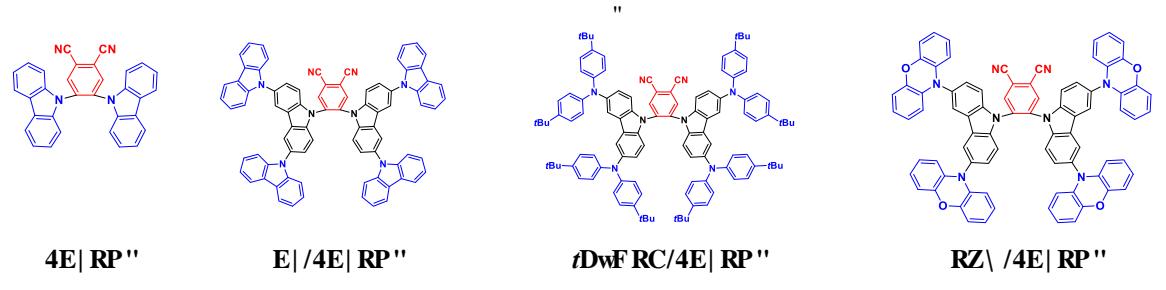
In order to better understand how the photophysical properties change with the extension of the donor group, we selected a well-known thermally activated delayed fluorescence (TADF) emitter 2CzPN [1-3] as a reference and synthesized a series of molecules with extended donor groups that include carbazole (Cz), diphenylamine (tBuDPA) and phenoxazine-based (PXZ) units. 2CzPN itself consists of an electron-withdrawing phthalonitrile core with two carbazole donor moieties attached. The additional donor units can be substituted comparatively easily at the 3,6-positions of carbazole, allowing for the conjugated π-system to extend. 2CzPN is thus ideally suited to study the impact of hole wavefunction delocalization on the singlet-triplet gap and TADF performance. By systematic investigation of photophysics in toluene solution and mCP film complemented with density functional theory (DFT) calculations, we demonstrate that extending the donor group essentially decreases the singlet-triplet gap at the cost of decreased PLQY or TADF property. In the case of Cz-2CzPN and tBuDPA-2CzPN, the singlet-triplet gap is successfully reduced yet stronger non-radiative losses are present compared to 2CzPN. In the case of PXZ-2CzPN, the oscillator strength becomes negligible indicating a too high HOMO LUMO decoupling. Here we not only report positive effects behind the extension of the donor group but also perform a comprehensive study to understand the energy loss channels in extended 2CzPN systems.
Fig. 1. Chemical structures of the compounds investigated.
[2] Kim, G. H.; Lampande, R.; Im, J. B.; Lee, J. M.; Lee, J. Y.; Kwon, J. H., Controlling the exciton lifetime of blue thermally activated delayed fluorescence emitters using a heteroatom-containing pyridoindole donor moiety. Materials Horizons, 4 (4), 619-624 (2017).
[3] Wong, M. Y.; Krotkus, S.; Copley, G.; Li, W.; Murawski, C.; Hall, D.; Hedley, G. J.; Jaricot, M.; Cordes, D. B.; Slawin, A. M. Z.; Olivier, Y.; Beljonne, D.; Muccioli, L.; Moral, M.; Sancho-Garcia, J.-C.; Gather, M. C.; Samuel, I. D. W.; Zysman-Colman, E., Deep-Blue Oxadiazole-Containing Thermally Activated Delayed Fluorescence Emitters for Organic Light-Emitting Diodes. ACS Applied Materials & Interfaces, 10 (39), 33360-33372 (2018).