
Terahertz (THz) spectroscopy is an effective method for the detection of organic and biochemical molecules. Nonetheless, in the current state, the use of THz spectroscopy in biochemical applications is limited to high concentrations of substances because of low sensitivity. Using plasmonic resonators (antennas) gives the opportunity to increase the sensitivity and allows to measure dilute substances.
Typical and well-known materials for plasmonics biosensors are noble metals, however they unsuitable for use in CMOS foundries. Highly doped semiconductors are promising in this wavelength range, as they show plasmonic behavior with limited losses. Here, we chose n-doped germanium as basis material for fabrication of microantennas and slots, whose resonance can yield the desired field enhancement at THz frequencies. Furthermore, germanium has the relevant advantage that it can be readily integrated in semiconductor foundry processes and thus offers potential for mass production, provided an optimization of the antenna response.
We have studied the material and fabrication parameters, as well as the antenna design, to target specific resonance frequency in the range 0.1-10 THz with the optimal quality factor. These features can be tuned by changing the size and geometry of the antenna. In order to choose the optimal Ge doping, the absorption of the material in the THz and IR range has been examined. We employ maskless photolithography for fabrication, which enables flexibility in pattering of different resonator geometries. The microstructures are subsequently defined via reactive ion etching or wet etching. Optimization of these processes is assessed with Scanning Electron Microscopy (SEM) and Atomic Force Microscopy (AFM). Finally, the performance of the antennas is studied by THz-time domain spectroscopy (TDS).
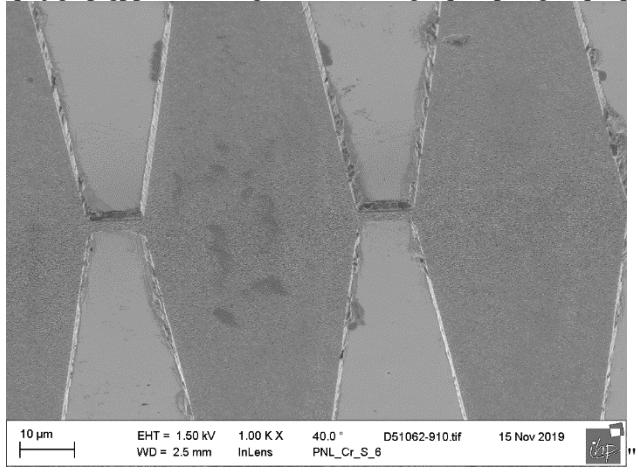
We will show these results for microantennas and slot antennas in two types of shape: (1) a dipole design with two rectangular arms and (2) bow-tie design with trapezoid arms. Moreover we studied the influence of the shape and distribution of resonator arrays on the antenna performance.
The THz-TDS data demonstrates that the shape of plasmonic antennas has an important impact on their optical properties. At least two resonant modes can be distinguished by observation in reflectance or transmittance geometry with an electric field polarization oriented along the short axis (high-frequency resonance) or the long axis (low-frequency resonance) of the resonators. In arrays, higher-order, coupled and collective resonances can be observed by increasing the number of resonators and manipulating their particular geometry.
THz-TDS measurements reveal that both the maximum absorption and the resonance of our slot antennas are sensitive to the mass concentration of a-lactose solutions in a range below 1 g/ml. This provides a proof-of-principle that this type of antenna is suitable for quantitative detection of biomolecules.