
Metal grating (MG) is a critical technique to study the optical properties of quantum structures in epitaxially grown samples [1]. It allows to change the direction of electric field of incident electromagnetic wave that it can couple with the confined electrons in the quantum system. As a result, one can optically measure the electronic structure of the quantum levels in simple experiment geometry [2]. In this work, the MG were deposited on the AlGaAs/GaAs samples and THz range optical response of the samples with MGs are studied. Two samples were used in the experiment. One consists of epitaxially grown AlGaAs on GaAs substrate, the other contains a superlattice of 35 pairs of GaAs/AlGaAs layers on GaAs substrate with GaAs/AlAs buffer.
The MG was fabricated using photolithography and thin metal film sputtering techniques. First, the surface of the samples was rinsed using acetone, isopropanol and deionized water. Next, the samples were covered with photoresist and a Mask Aligner SUSS MA/BA6 Gen 4 was used to form the negative photoresist pattern by exposing the samples to UV light through the mask. Then, metalization of 20 nm/180 nm Ti/Au were deposited in vacuum by a E-Beam TFDS-870 equipment. Finally, the samples were immersed in the DMSO to remove remaining photoresist and washed in deionized water. The optical absorption spectra were measured using Fourier transform spectrometer Nicolet 8700 (Thermo Fisher Scientific, U.S.A.).
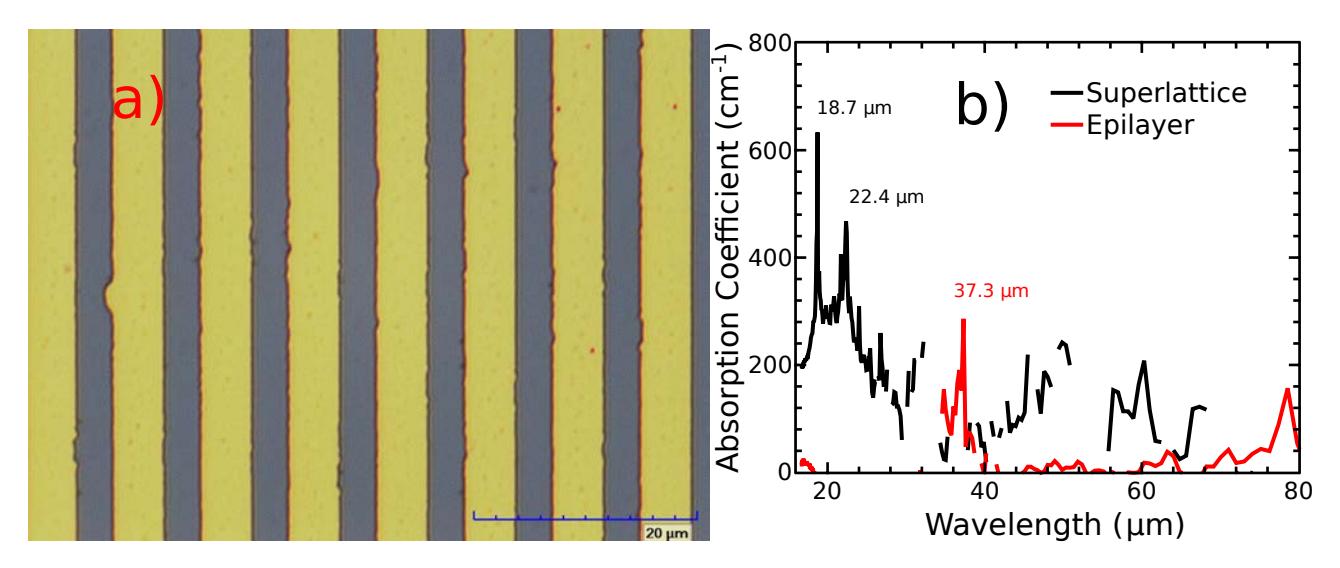
Fig. 1a shows the MG on the sample surface under the optical microscope. One can see perfectly aligned metal stripes although the edges of the stripes are slightly uneven. The filling factor of the grating is around 0.6 and the period of the grating is 8 μm. The measured optical absorption coefficient spectrum reveals the strong resonance absorption lines at 18.7 μm and 22.4 μm for superlattice sample, as one can see in Fig. 1b. The reference sample with AlGaAs epilayer shows the single absorption resonance line at 37.3 μm
For conclusions, the high-quality MGs were fabricated using photolithography and thin metal film sputtering. The absorption coefficient spectra of the samples show well defined resonance lines. The peaks of superlattice sample at 16 THz and 13.4 THz frequencies may tentatively be attributed to THz radiation coupling with the electrons in the quantum system, whereas the peak of AlGaAs epilayer sample at 8 THz – to the THz radiation coupling with the phonons system.