ZnO nanoparticles have attracted great interest due to their exceptional properties such as defect-induced ferromagnetism, UV sensing and reversible transition from hydrophobicity to hydrophilicity [1] [2]. ZnO nanotetrapods, synthesized by combustion methods [3] are one of various morphologies of ZnO which are used for optoelectronical and photovoltaic applications to reduce the reflection of light from surface. These type of coatings are called anti-reflective [4].
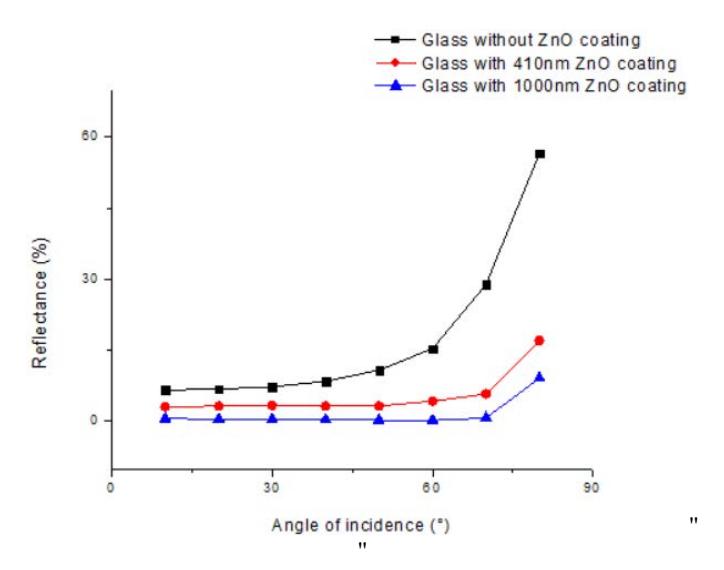
In this work, a simple method of spraying was used to deposit anti-reflective coating of ZnO nanoparticles on glass substrate. The thickness of coating was measured by custom UV transmittance meter. Reflectance, transmittance and other optical properties were investigated by special optical setup, which includes spectrometer. Multifunctional nature of ZnO nanoparticle anti-reflection coatings was observed: such coatings are more neutral to light polarization and reflect less incident light. Moreover, characteristic of UV blocking was observed in reflectance and transmittance near the edge of UVA (~400nm).
Fig. 1. Light reflection dependence on angle of incidence (λ = 632.8nm).
[1] Y. K. Mishra and R. Adelung, "ZnO tetrapod materials for functional applications," Mater. Today, vol. 21, no. 6, pp. 631-651, 2018, doi: 10.1016/j.mattod.2017.11.003.
[2] X. Feng, L. Feng, M. Jin, J. Zhai, L. Jiang, and D. Zhu, "Reversible Super-hydrophobicity to Super-hydrophilicity Transition of Aligned ZnO Nanorod Films," J. Am. Chem. Soc., vol. 126, no. 1, pp. 62-63, 2004, doi: 10.1021/ja0386360.
[3] S. Rackauskas et al., "A novel method for continuous synthesis of ZnO tetrapods," J. Phys. Chem. C, vol. 119, no. 28, pp. 16366–16373, 2015, doi: 10.1021/acs.jpcc.5b03702.
[4] H. K. Raut, V. A. Ganesh, A. S. Nair, and S. Ramakrishna, "Anti-reflective coatings: A critical, in-depth review," Energy Environ. Sci., vol. 4, no. 10, pp. 3779-3804, 2011, doi: 10.1039/c1ee01297e.