
Wettability is a very important surface property for range of tools, implants and devices operating in a watery environment. Processing of solids near their ablation threshold by high intensity polarized laser irradiation may lead to the development of regular nanoscale structures known as Laser-induced Periodic Surface Structures (LIPSS). Applying LIPSS to a surface can lead to numerous applications of surface functionalization including but not limited to improved wetting performance [1], antibacterial activity [2], low optical reflectance [3]. On top of that, wettability can be controlled by varying laser parameters around required LIPSS developing conditions. This has a huge impact on process optimization and structuring time, which is very important for large scale manufacturing. It was reported that wettability properties of the LIPSS structures is prone for aging become even more hydrophobic after exposure to atmosphere [4].
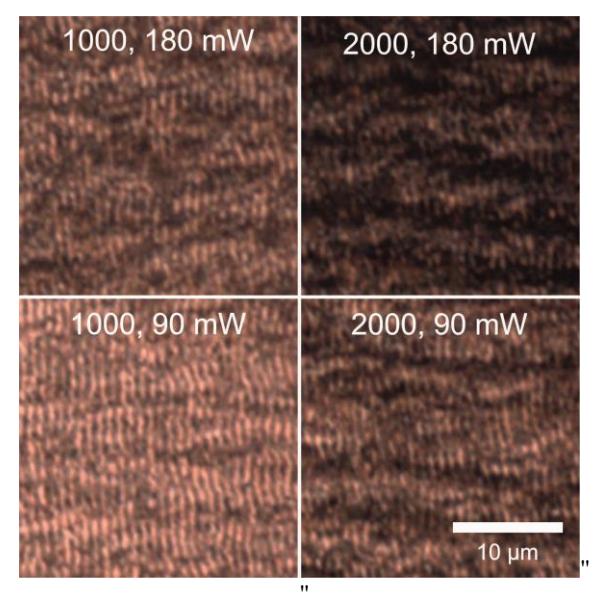
In this work, the fundamental harmonic (1030 nm) of a linearly polarized Yb:KGW femtosecond laser beam was scanned employing a galvoscanner and a f-theta lens over the surface of a stainless steel mirror while varying the pulse energy, pulse density, and laser spot overlap. Two pulse energy density values were used 223 and 447 mJ/cm2 as well as pulse densities of 1000 and 2000 pulses per millimeter while the pulse repetition rate was kept at 200 kHz. The wettability of the surfaces was evaluated using the sessile drop method where 1 μL volume droplets of water were dispensed on the pristine and differently treated surfaces. Optical microscope images of the laser-treated samples are depicted in Fig. 1.
Laser treatment varying energy density enabled control of the wetting angle for water in a wide range spanning from 97° to 131° for deionized water. The contact angle was increased by 87° compared to pristine surface. The highest water contact angle values were obtained after 14 days of laser processing. Faster processing is obtained using 1000 pulses per millimeter with the price of 18° smaller water contact angle.