
Photoelectrochemical (PEC) water splitting has been widely considered as one of the most promising technologies in clean, green, and renewable energy production [1]. Moreover, numerous studies suggest that various transition metal oxides are the most promising candidates as photoanodes for PEC materials, especially when used in conjunction.
Our aim was to synthesize p-n heterostructure of spinel type ZnCo2O4 coatings, investigate the influence of morphology on its photoelectrochemical properties, and test them as prospective materials to catalyze oxygen evolving reaction (OER).
Spinel type ZnCo2O4 coatings were synthesized using two-step process (Fig.1):
chemical precipitation (Zn:Co ratio 1:2 and 1:1) and thermal decomposition at 500 °C for 2 h,
spin-coating technique (the rotation speed of 1000 and 1200 RPM)
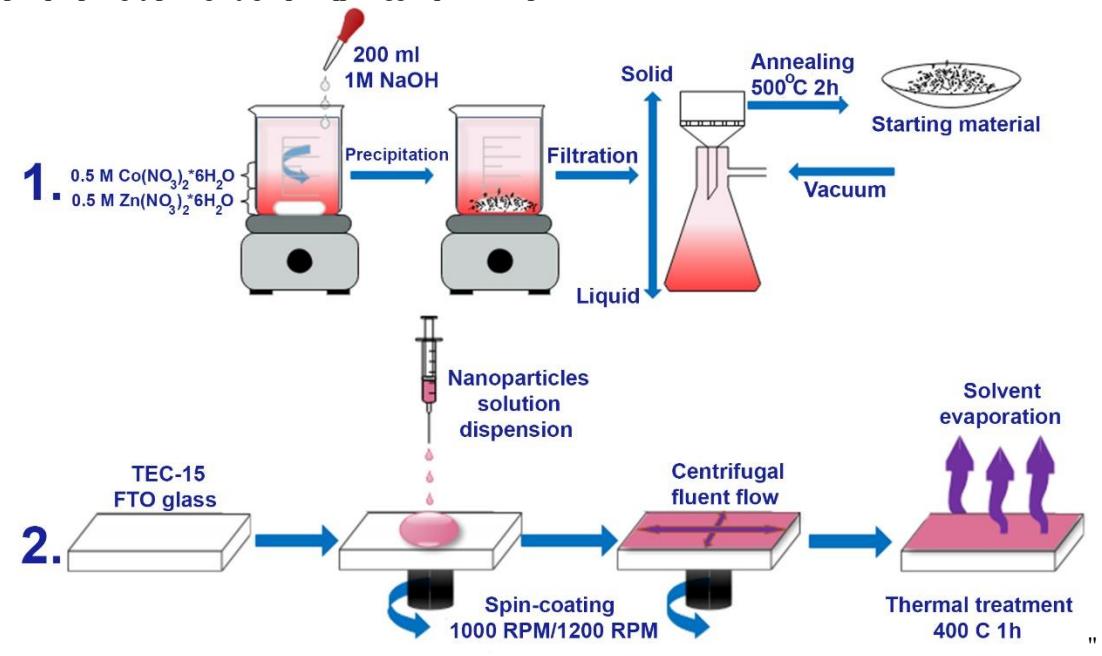
Composition, structure and morphology were investigated using various techniques such as: scanning electron microscopy (SEM), adsorption / desorption measurements, X-ray energy dispersion spectroscopy (EDS), X-ray diffraction (XRD), N2 adsorption / desorption measurements and specific surface area calculations were used. Galvanostatic charge-discharge measurement and linear sweep voltammetry were used in order to investigate photoelectrochemical properties and coatings capacitance.
Ratio change from 1:1 of Zn:Co to 1:2 led to formation of different structure, morphology and properties:
The obtained Zn:Co 1:1 coatings were more rough, granular and thicker (662 nm); with pore size 18.32 nm and 0.55 cm3/g volume, as well as 57.92 m2/g specific surface area and active surface area A=0.14 cm2 at E=0.85 V vs. Ag, AgCl|KCl(sat). These coatings demonstrated the incident- to photon efficiency (IPCE) of 22.4% and the applied bias photon-to-current (ABPE) 3.18%;
Zn:Co 1:2 coatings formed uniform, 442 nm thick, vertically, horizontally aligned porous lamellar sturcture; pore size 17.97 nm and 0.14 cm3/g volume, 24.41 m2/g specific surface area; active surface area A=0.26 cm2, at E=0.85 V vs. Ag, AgCl|KCl(sat) IPCE 37%; ABPE 5.91%.
Due to great photoelectrochemical performance, we anticipate that the comprehensive analysis of such p-n heterostructure ZnCo2O4 will be important for future applications in OER.