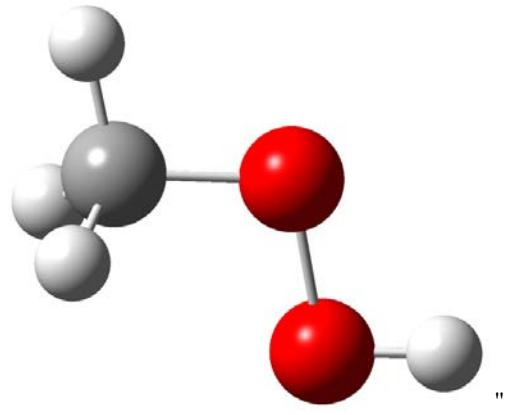
Earlier we have reported our data on torsional IR spectrum of the methyl hydroperoxide (HOOCH3) molecule calculated at MP2/cc-pVQZ level of theory [1]. The method used for calculation is described in [2-6]. This molecule (see Fig.1) has two internal tops: the hydroxyl group (OH) which can rotate around the O-O bond and the methyl group (CH3) which can rotate around the C-O bond.
Fig. 1. The equilibrium structure of the methyl hydroperoxide molecule.
According to [1] calculated value of the hydroxyl group tunneling frequency of the methyl hydroperoxide molecule in the ground state is equal to 19.23 cm-1. However, the experimental value of the hydroxyl group tunneling frequency according to [7] is equal to 14.97 cm-1. We assumed that this disagreement between theory and experiment in the hydroxyl group tunneling frequency of the methyl hydroperoxide molecule occurs due to the failure to take into account zero point vibrational energy (ZPVE). Since authors of the [8] have took into account ZPVE of the methyl hydroperoxide molecule in the harmonic approximation, we decided to calculate this energy in anharmonic approximation. Because calculation of the IR spectrum in anharmonic approximation takes a lot of time we carried out this work using MP2/cc-pVTZ level of theory. After ZPVE was calculated it was added to 2D potential energy surface and this total energy was used to calculate tunneling frequency for the hydroxyl group. In this case, it turned out to be equal to 13.03 cm-1. One can see that this result is much closer to the experimental one.
[1] Uladzimir Lazicki, Torsional spectrum of the Methyl Hydroperoxide molecule calculated at MP2/cc-pVQZ / Uladzimir Lazicki, Zlata Lepenkova, Darya Kisuryna, Alex Malevich, George Pitsevich, Vitas Balevicius // Open Readings 2020: 63nd Scientific Conference for Students of Physics and Natural Sciences: programme and abstracts/ Vilnius University; – Vilnius, 2020. – P.300
[2] G. Pitsevich, A. Malevich, V. Sapeshko, J.Mol.Spectr., 360 (2019) 31-38.
[3] G. Pitsevich, A. Malevich, V. Sapeshko, Chem. Phys., 530 (2020) 110633.
[4] G. Pitsevich, A. Malevich, F. Markovich U. Sapeshka, Mol. Phys., 118 (2020) e1746425
[5] G. Pitsevich, A. Malevich, D. Kisuryna, A. Vasilevsky, A. Vasilevich, U. Sapeshka, A. Kamnev, Spectrochim. Acta, Part A, 239 (2020) 118209.
[6] G. Pitsevich, A. Malevich, D. Kisuryna, A. Ostyakov, U. Sapeshka, J.Phys. Chem., A, 124 (2020) 8733-8743.
[7] M. Tyblewski, T.-K. Ha, R. Meyer, A. Bauder, C. Blom, J.Chem. Phys., 97 (1992) 6168-6180.
[8] S. Dalbouha, M. Senent, N. Komiha, J.Chem. Phys., 142 (2015) 074304.