
Potential energy surface is an important characteristic of molecules and clusters. To be able to take into account symmetry properties of considered molecules it is important to calculate energy values at the nodes of the multidimentional equidistant grid. Usually there is no problem with this aspect with valence and bending coordinates. However, this problem arises every time when one of the tops on internal rotation axis contains more than one atom. One of such tops is CH3 (methyl) group and dimethyl peroxide molecule (as example, see Fig.1) contains two of these tops.
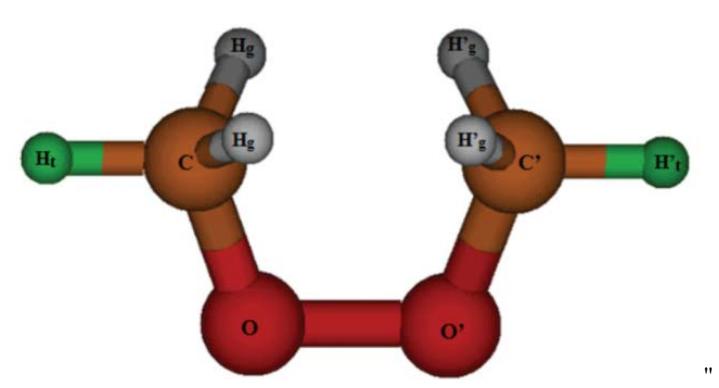
It is clear that the internal rotation of the CH3 groups in dimethyl peroxide molecule around C-O bonds is one dimensional vibrational task. Since carbon atoms are connected with three hydrogen atoms, torsional coordinates $γ_1$ and $γ_2$ must be determined as the average of the sum of three dihedral angles:
$$\gamma_1 = (\angle H_t COO' + \angle H_g^1 COO' + \angle H_g^2 COO'):3\tag{1}$$It is well known that CH3 group loses its C3v local symmetry. It means that the dihedral angles ∠HtCHgO are not equal to 120° and can change during internal rotation. One can see that the value of $γ_1$ = 60° can be obtained by many different ways (see (1)). Thus, that several values of potential energy and kinematic coefficients will correspond to one value of the torsion angle. To avoid this problem only one dihedral angle (for example ∠HtCOO') is frozen while the values of two other dihedral angles are determined during optimization process. However, the resulting value of the torsional coordinate will slightly differ from the desired one.
In this work, we introduced two methods of the transition from non equidistant to equidistant grid for the torsion coordinate of the CH3 group when calculating multidimensional potential energy surfaces. The first one is based on interpolation by cubic splines. While the second one is based on solving a system of linear equations using least squares methods. Results of both methods are compared.