
Hybrid organic-inorganic perovskites are very promising materials for various optoelectronic applications since during one decade solar cells, LEDs, lasers [1], transistors [2] and photodetectors [3] were created using these compounds. Perovskites have many desirable properties such as solution processibility at low temperatures, high carrier mobility and a tunable bandgap. The energy bandgap tunability can be achieved by mixing cations or exchanging anions and it allows us to manufacture perovskites with different emission and absorption wavelengths which is very useful while finetuning designs of LEDs or tandem solar cells. Therefore, mixed cation perovskites require further research to determine optimal composition with the best optoelectronic parameters.
The main goal of this work was to study perovskite samples FAxMAyCS(1-x-y)PbHA3 (FA – phenylammonium, MA – methylammonium, HA – halide ions) of different chemical composition where ratio of cations was gradually changed. Carrier dynamics was investigated using light-induced transient grating (LITG) technique. From these measurements important photoelectric parameters such as diffusion coefficient and recombination lifetime were obtained.
Pulsed laser irradiation at 351 nm wavelength was used to excite the samples. Spatially modulated excitation caused the creation of transient grating. This grating decayed with time due to diffusion and recombination processes and it was monitored by the probe beam of 1053 nm which was delayed by an optical delay line. Photoelectric properties were investigated within the wide range of excess carrier density by employing an optical attenuator to control the excitation energy fluence. Diffraction efficiency (${\eta}$) decays, measured at different grating periods ${\Lambda}$, allowed us to extract carrier lifetime (${\tau}_{R}$) and diffusion coefficient (D).
Carrier lifetime dependence on the excess carrier density in MAxCS(1-x)PbBr3 samples can be seen in fig. 1 (a). ${\tau}_{R}$ decreases with growing excess carrier density (${\Delta}N_{av}$) due to Auger recombination. Furthermore, increasing part of cesium in compound decreases carrier lifetime which can be explained by poorer crystal ideality and deceasing symmetry.
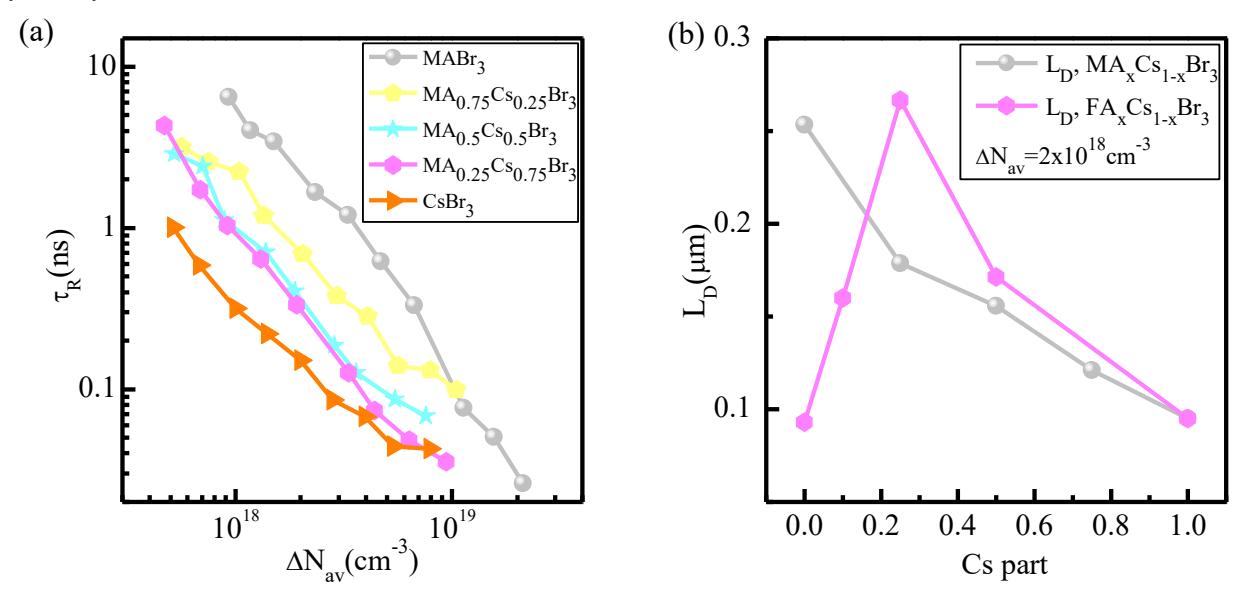
In fig. 1 (b) diffusion length dependence on Cs part in the compound is shown. It is evident that diffusion length decreases with more Cs and is attributed to decreasing crystal ideality. However diffusion length varies in the interval of $0.1 \div 0.3 \,\mu m$ which is comparable to thickness of the layers. This fact allows us to conclude that such perovskites are suitable for optoelectronic applications where charge carriers have to diffuse from the active layer.