
Periodontitis (PD) is highly prevalent inflammatory oral disease affecting the supporting tissues of the teeth and leading to connective tissue attachment loss and bone resorption. Besides its negative impact on quality of life, PD is also strongly associated with an increased risk of particular systemic disorders, e.g., respiratory and cardiovascular diseases, rheumatoid arthritis, diabetes, cancer etc. [1-5]. Various mechanisms of PD pathogenesis are epigenetically regulated and microRNAs (miRNAs) are considered as one of the key modulators that influences periodontal homeostasis. This study aimed to reveal PD-associated miRNAs in gingival tissue and bodily fluids, including gingival crevicular fluid (GCF), saliva and plasma, and to evaluate the utility of those miRNAs as minimally- and non-invasive diagnostic markers for PD.
MiRNA expression was profiled in eight gingival tissue samples using microarray platform (Human miRNA Microarrays, 8x60K format). Four significantly differently expressed miRNAs were validated in gingival tissue samples (N=61) and further analyzed in bodily fluid specimens (N=171) by means of quantitative reverse transcription PCR.
A number of miRNAs was found to be significantly upregulated in inflamed gingival tissues as compared to periodontally healthy tissues. After thorough validation, miR-199a-5p, miR-483-5p, miR-3198 and miR-4299 were analyzed in bodily fluids. The level of GCF miR-3198 was significantly higher amongst participants with PD (P=0.019). The level of miR-199a-5p was increased in saliva samples from patients with severe PD (P=0.045), and decreased in plasma samples collected from PD-affected patients (P=0.008), as compared to periodontally healthy participants (P<0.050). A combination of GCF miR-3198 and miR-4299 demonstrated high diagnostic potential (AUC=0.86, P<0.0001) with 68% sensitivity and 96% specificity (Fig. 1).
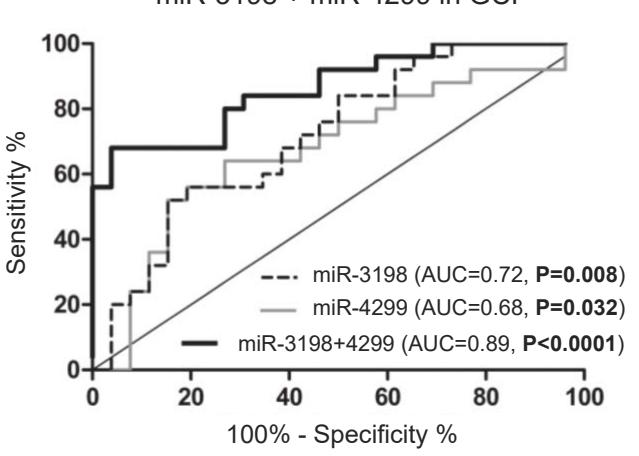
The results of the current study suggest that PD-specific inflammatory miRNAs in bodily fluids can serve as potential biomarkers of PD that could be applied for minimally- and non-invasive diagnostics of the disease.