Terahertz (THz) frequency range of the electromagnetic (EM) wave spectrum is known for unique properties, such as the ability to pass through dielectric materials that are non-transparent to visible light (paper, wood, textile), that have various applications [1, 2]. Currently available THz sources are cost ineffective, either suffer from limited operating frequency range or require cryogenic temperatures, and contain intricate inner structure that results in complex manufacturing processes [3]. As an alternative, thermal sources providing broad-band thermal radiation specifically tailored to narrow emission lines of desired frequency could be used, allowing for the mitigation of the above-mentioned limitations. In this work, the n-GaAs/GaAs-based semiconductor structures with specially designed metasurfaces for narrow (selective) THz emission are investigated. The metasurface was etched into the top n-GaAs layer structured as a periodic array of rectangle-shaped metacells with side lengths ranging from 14 m to 23 m to form pillar-like structures. Three samples with different electron concentrations in metasurface layers were fabricated.
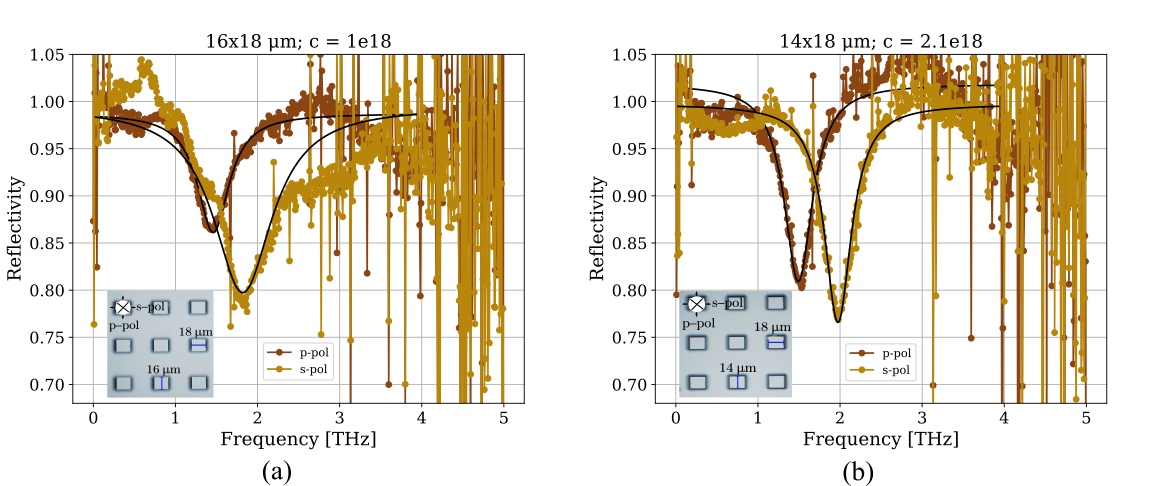
Reflectance of samples equipped with metasurfaces were investigated both theoretically and experimentally. Reflection spectra (Fig. 1) were measured at normal incident angle by commercial THz time-domain system (Teravil, T-SPEC 800), with flat gold plate as a reference. It was observed that by changing electron concentration of the n-GaAs layers the resonance frequency can be tuned. Resonant frequency of structures with electron concentration of \(1\times10^{18}\) cm-3 reached 1.82 THz for s- and 1.46 THz for p-polarization and for structures with \(2.1\times10^{18}\) cm-3 electron concentration the frequency of the first harmonic reached 1.97 THz and 1.49 THz for s- and p- polarization, respectively.