Accurate measurement of shear stress at the cell–substrate interface is crucial for understanding cell behavior in organ-on-a-chip (OOC) systems, where mechanical forces regulate processes such as cell alignment and differentiation. Precision of traditional methods heavily depend on the spatial resolution of Particle Image Velocimetry (PIV) measurements and are further compromised by noise inherent in PIV data, which amplifies uncertainties in local shear stress estimation [1].
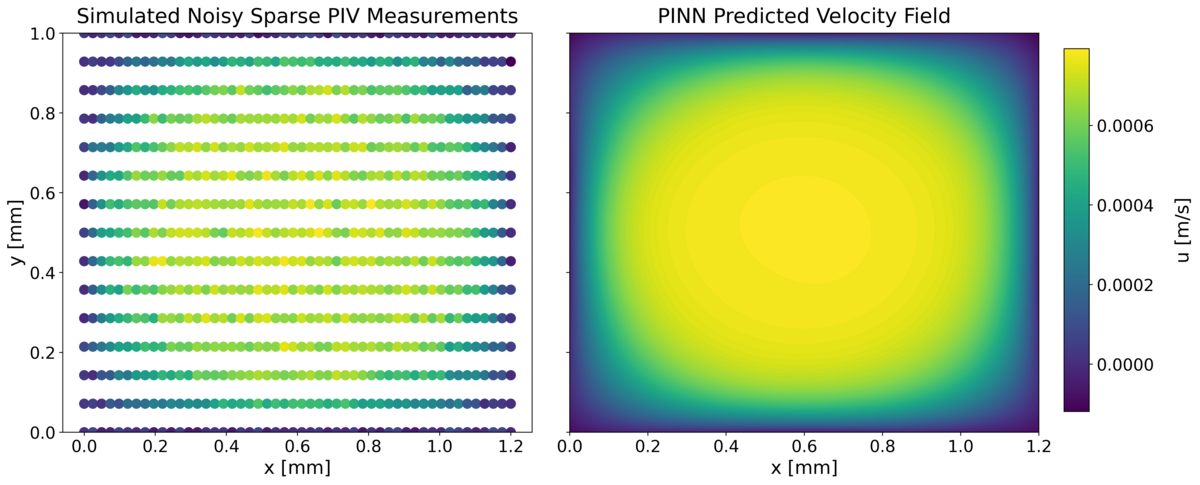
In this work, we address the inverse problem of reconstructing a continuous flow field from sparse 2D PIV data using Physics-Informed Neural Networks (PINNs) [2]. By embedding the Navier–Stokes equations and incorporating a power-law formulation of the medium’s non-Newtonian rheology directly into the loss function, our approach captures the complex fluid behavior while enforcing physical constraints during neural network training. The main goal of our research is to define the cell–substrate boundary and compute local shear stress with high spatial resolution and precision.
Using well-defined simulations with known ground truth, we demonstrate that our technique provides improved boundary detection compared to conventional image processing methods and generates shear stress maps that accurately capture the medium’s detailed rheological behavior. Moreover, our PINN-based approach exhibits robustness to noise in PIV measurements, resulting in more reliable flow reconstructions. These refined maps support more informed microfluidic device design and enhance the evaluation of in vitro models for biomedical research.