
Holographic vibrometry is an interferometric method for the fast and spatially resolved characterization of surface vibrations on the nano- and picoscale [1]. Similar to laser Doppler vibromery (LDV), it exploits the Doppler shift light experiences when it is reflected from a moving object. It allows for a full-field measurement instead of relying on a point-by-point scanning process and thus offers very fast measurements. This is crucial when measurements are to be performed in production or quality control.
In the following, we assume light with frequency \(f_L\) which is reflected from an object surface harmonically vibrating with frequency \(f_{obj}\) and displacement amplitude \(\hat{z}_{obj}\). This corresponds to a harmonic phase modulation which generates sidebands at \(f_L\pm m\cdot f_{obj}\) as illustrated in equation (1) using the Jacobi Anger identity. The object displacement is thus encoded in the amplitude factors of the different spectral components which are given by the Bessel functions \(J_m\). \[e^{i 2\pi f_L t}\cdot e^{i\frac{4 \pi \hat{z}_{obj}}{\lambda}\sin{(2 \pi f_{obj} t)}}\ = \sum_m J_m \left(\frac{4 \pi \hat{z}_{obj}}{\lambda}\right) \cdot e^{i \left(2 \pi (f_L + m f_{obj}) t\right)}, \ \ m \in Z\] For displacements smaller than \(\approx\) 10 nm, \(J_0\) is close to unity and \(J_n \approx 0\) for \(n\geq2\) but \(J_1\) is approximately proportional to the displacement \(\hat{z}_{obj}\). By recording a hologram of this spectral component at \(f_L\pm f_{obj}\) and reconstructing its image in the object plane by numerical Fresnel backpropagation, the spatial distribution of the sideband amplitude and thus the vibration displacement across the object’s surface is obtained.
In practice, this is achieved by shifting the frequency of the light in the reference arm by \(\Delta f = f_{obj}\) using acousto-optic modulators, such that it matches the frequency of the sideband. A frequency shift of \(\Delta f = f_{obj}+f_b\) leads to a beat frequency \(f_b\) between the reference arm and the first sideband in the object arm. If a sequence of images is recorded, narrow-band filtering can be employed in the frequency domain to boost the SNR according to the working principle of a lock-in amplifier. 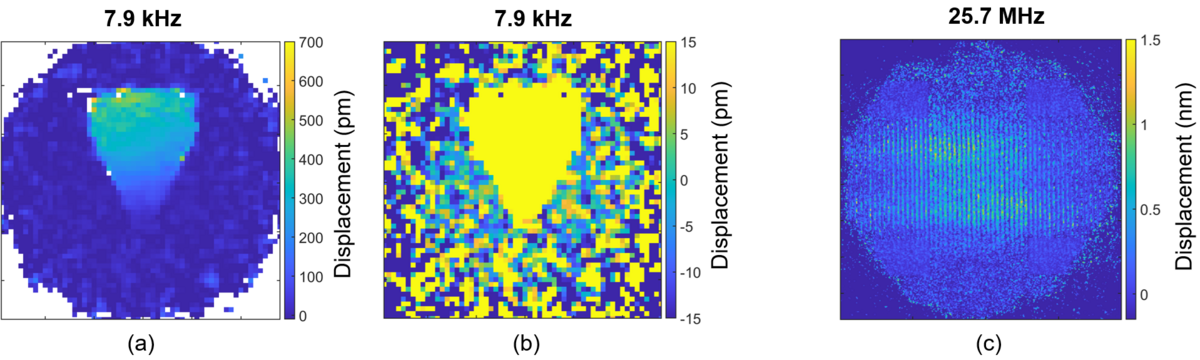
IMAGING OF SURFACE ACOUSTIC WAVES AND MEMS WITH PICOMETER DISPLACEMENTS USING HOLOGRAPHIC VIBROMETRY
Florian Dötzer1, Johannes May1, Marie Mannagottera1, Stefan Sinzinger1
1 Optical Engineering Group, Department of Mechanical Engineering, TU Ilmenau, Germany
Fig. 1. Vibration displacement of a MEMS cantilever (a), magnified colorbar to assess noise floor (b) and vibration displacement of a surface acoustic wave.
[1] N. Verrier et al., Full Field Holographic Vibrometry at Ultimate Limits, New Techniques in Digital Holography, 255-293 (2015)
[2] R. Weser et al., Three-dimensional heating and patterning dynamics of particles in microscale acoustic tweezers, Lab on a Chip (2022)