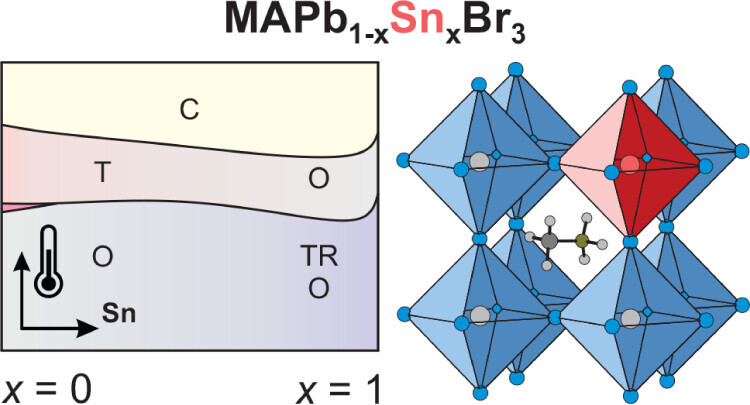
$ Sn\(_{x}\)Br\(_{3}\) HYBRID PEROVSKITES} Ion mixing is a powerful strategy for tuning the performance and stability of hybrid perovskite-based photovoltaic devices. While A- and X-site mixing have been extensively studied, the effects of B-site mixing on the structural and dynamic properties of MA-based perovskites remain less explored [1].
In this study, the structural and dynamic properties of mixed lead−tin halide perovskites MAPb\(_{1-x}\)Sn\(_{x}\)Br\(_{3}\) are primarily investigated using broadband dielectric spectroscopy. Complementary experiments, including differential scanning calorimetry and nuclear quadrupole resonance, performed by colleagues, enabled the mapping of the temperature–composition phase diagram. The results indicate that B-site mixing slightly stabilizes the cubic phase, although its influence on structural phase transitions is less pronounced compared to A- and X-site mixing.
Dielectric measurements further reveal that B-site mixing increases the number of dynamically active MA cations in the low-temperature phase, substantially disrupting the long-range ordering of the organic sublattice and suggesting the formation of a glassy phase [2]. Additionally, the increased activation energy in mixed compounds indicates that B-site mixing raises the reorientation barrier of MA cations.
These findings provide insights into the complex interplay between structural and dynamic properties in mixed-metal perovskites, contributing to their potential optimization for photovoltaic applications.