It was noticed long ago that some cells in suspension can arrange themselves into nearly perfect spherical 3D clusters. In the last decade the 3D cell spheroids became a powerful tool for analysis. Unlike the usual 2D monolayer cell cultures, the spheroids can mimic the cell-cell and not only cell-environment interactions. This way the spheroids are used for drug-delivery and screening or tumor research. However, the spheroids formed in a suspension are irregular with poor preparation efficiency [1]. Droplet microfluidics helps us to isolate single cells or molecules into water droplets of constant volume in carrier oil phase. More recent applications allow us to produce the droplets which can be later crosslinked into polymer capsules. Coupling the single cell encapsulation, cultivation and the shell permeability allows for cell division and growth [2].
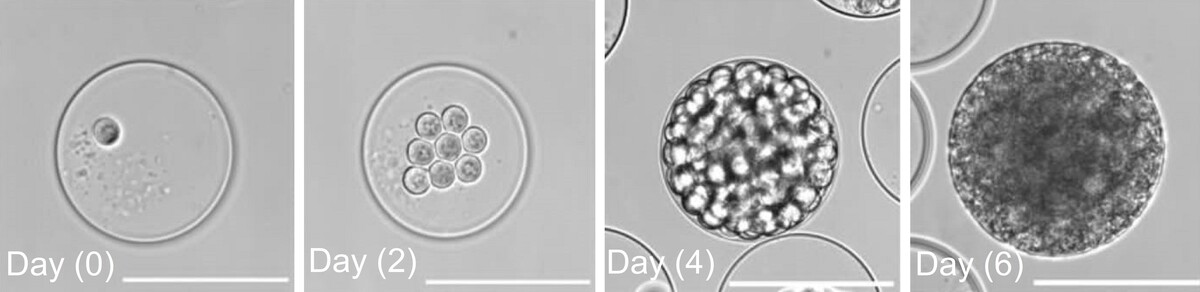
Cell spheroids were grown from the single cells encapsulated into the droplets. The droplets were produced in a microfluidic PDMS-glass chip. The chips are replicated from a silicon-SU8 mold produced by using a soft-litho-graphy method. Using the polymer of high molecular weight (Dextran 500K) we assure a consistent encapsulation of one cell per capsule. Adjusting the flow rates of oil and water phases (Dextran and gelatine) we get the capsules of 60μm in diameter. Two water phases separate to form a gelatine-shell and liquid dextran-saturated core. After crosslinking the cells within the capsules are taken into the cell-growth media for further incubation. Since pore size is too small for Dextran molecule to pass, the polymer is kept inside the capsule adjusting to the osmotic equilibrium. The cell-growth media can reach the cells allowing them to multiply. Eventually the spheroid occupies the volume of capsule and proceeds to grow by deforming a shell (Figure 1). Contrary to other works, here we do not find apoptotic cells [3].
We find the growth of spheroid-radius follows different power-law before and after spheroid confluence. We expect it to be the result of cell compression and rearrangement. This allows us to estimate the bulk modulus of the spheroid- an analog to the Young’s modulus. The Young’s modulus for the empty capsule was estimated from the relative deformation with an osmotic pressure.
We take the balance of the elastic energy of the shell deformation and the energy created by spheroid. Then we find the pressure created by spheroid over the time of growth. There’s no pressure change until confluence. In later stages there are elastic and plastic (permanent) deformations. Overall, the curve is similar to stress-strain curve for any bulk material. This way the growing spheroids might give an insight into the mechanical stability of capsules.