Solar energy is one of the most widespread types of renewable energy, and much attention is currently being paid to the development of perovskite solar cells. Perovskite solar cells are a rapidly developing third-generation technology that has already achieved higher energy conversion efficiency than silicon solar cells [1]. The production of perovskite solar cells is simpler, the cells themselves are light and flexible, which increases their industrial application possibilities. Despite these advantages, perovskites are very sensitive to environmental factors, and various crystal lattice defects are formed during production. Most often, chemical passivation of the perovskite surface with organic salts is used to reduce or eliminate these defects [2].
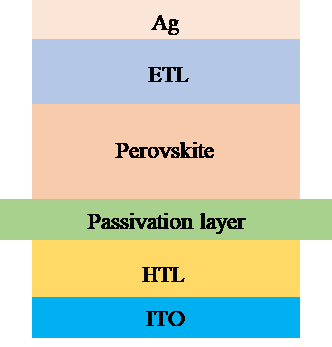
It was found that the isothiouronium group interacts well with the perovskite layer, so compounds containing this functional group are suitable for perovskite passivation. The interface between hole transport layer and perovskite is also important to ensure the highest possible efficiency of the solar cell. The efficiency of fabricated perovskite solar cells has been improved when organic isothiouronium compounds with a phosphonic or carboxylic acid anchoring groups are used for the bottom passivation of perovskite solar cells [Fig. 1]. Phosphonic or carboxylic acid anchoring groups interacting with hole transport layer ensure fast charge transportation improving overall performance of perovskite solar cells [3]. In this work, bifunctional passivation agents combining isothiouronium ionic head and phosphonic or carboxylic acid fragments were compared and the effect of the resulting compounds on perovskite solar cells is evaluated.