
Carbonic anhydrase (CA) is an enzyme responsible for carbon dioxide’s reversible reaction to bicarbonate ( \(CO_2 + H_2O \rightleftharpoons HCO_3^- + H^+\) ). While this chemical reaction can occur spontaneously, its rate is often insufficient to meet living organisms’ needs. To address this issue, most organisms have evolved one or more forms of CA to enhance the reaction rate [1].
There are currently eight distinct evolutionary unrelated classes of CAs found, denoted by Greek letters: α, β, γ, δ, ζ, η, θ, and ι. Among these classes, four – α, β, γ, and ι – can be found in bacteria and fungi. In these organisms, enzymes play a vital role, including the transport of bicarbonate and CO\(_{2}\), pH regulation, ion and water transport, and carbon fixation in photosynthetic bacteria [2].
Microorganisms that produce β-carbonic anhydrases (β-CAs) can thrive in extreme environments, such as those with high salt levels, acidity, or alkalinity. This ability makes these enzymes very useful in biotechnology. Recent studies have demonstrated that β-CAs can be applied in biomedical research and drug development [3]. They are also being explored for their role in carbon capture technologies, where they help convert CO\(_{2}\) emissions into valuable products [4]. Furthermore, they can serve as biocatalysts in industrial processes, often under harsh conditions. As more enzymes that can withstand extreme environments are discovered, the future for β-CAs looks promising.
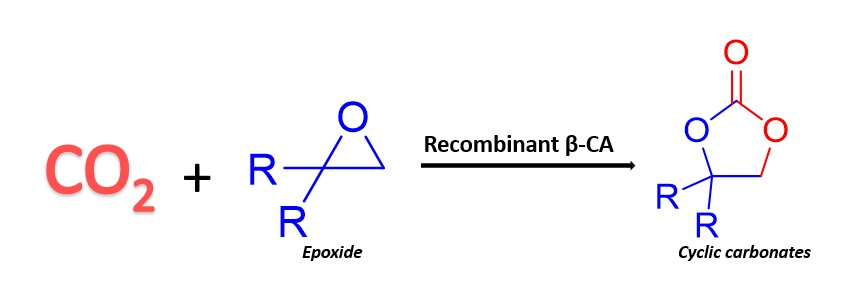
With this study, we aim to produce recombinant β-CAs and establish the technology for the enzymatic synthesis of cyclic carbonates (Fig. 1).
This project has received funding from the Research Council of Lithuania (LMTLT), agreement No S-MIP-24-49.