Pyrethroids are synthetic pesticides widely used for pest control in agricultural and public settings, but their high insecticidal potency, persistence, and slow degradation can harm non-target organisms and contaminate natural habitats [1]. Bacteria produce different lipolytic enzymes - carboxylesterases and true lipases which are multifunctional biological catalysts and have been the subject of research for a long time. Although lipolytic enzymes are mainly known as enzymes catalyzing the hydrolysis (and other transformations) of ester-bonded lipid substrates, it has been discovered more recently that they are also capable of breaking down the ester linkages of pyrethroids and can thus serve as an efficient and eco-friendly method for their removal [1,2].
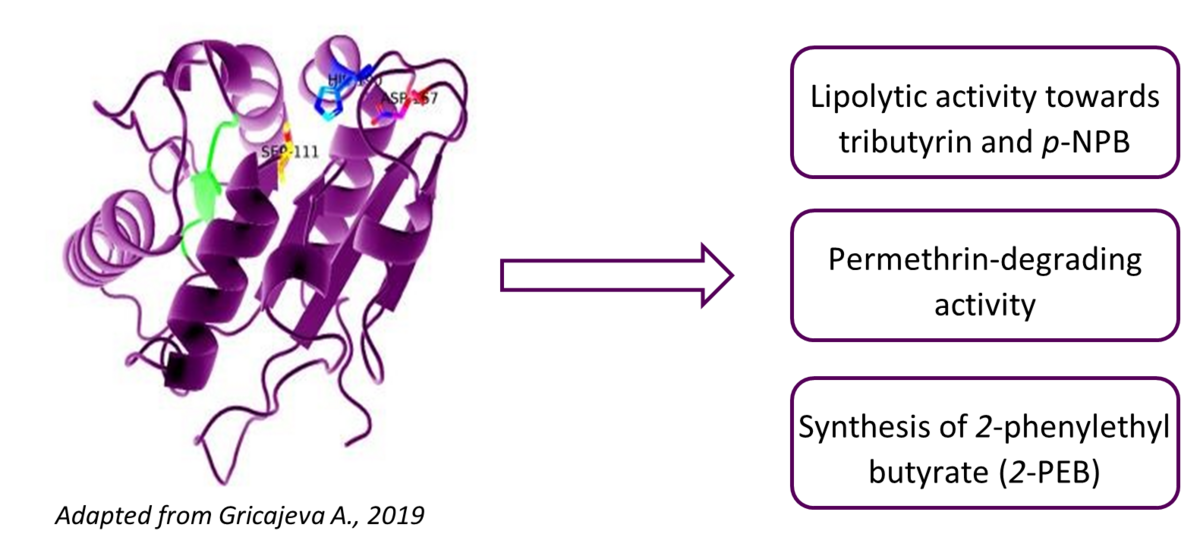
In this study, plant growing substrate samples from two Lithuanian farmlands were used to isolate pyrethroid-degrading bacteria through enrichment culture with pyrethroid (permethrin) as the sole carbon source. Isolated cultures were selected and identified employing 16S rDNA analysis. After identification of target bacteria, 7 bacterial cultures belonging to the Pseudomonas spp. (II1; II3; II10; IIB; IIC), Rhodanobacter sp. (II14), Priestia sp. (III3) genus, were selected for further study based on their lipolytic and pyrethroid-degrading activity (Fig. 1). The lipolytic enzymes located in extracellular media were salted out using ammonium sulphate and gel filtrated. Intracellular proteins were derived from bacteria via sonication. Lipolytic activity of both partially purified protein fractions was determined using p-NPB assay.
Partially purified proteins from the extracellular medium of Pseudomonas spp. (II1; II3; IIB) and Rhodanobacter sp. (II14), as well as intracellular proteins of Pseudomonas sp. (II10) and Rhodanobacter sp. (II14), formed hydrolysis zones in permethrin (tested by agar diffusion method). To determine the size of target proteins a zymography was used. Zymography analysis showed that all tested protein fractions formed tributyrin hydrolysis zones, Pseudomonas sp. (IIB) total cell protein (TCP) fraction was active toward both tributyrin and permethrin in the zymography gels.
Enzymes, partially purified from the extracellular and cell’s intracellular fractions, were used for the synthesis of -phenylethyl butyrate (-PEB). This method was chosen to evaluate the ability of the obtained protein solutions to perform esterification reactions, resulting in the production of -PEB, an ester widely used in the fragrance and flavor industry (Fig. 1).