Development of functional nanomaterials requires a deep understanding of how organic molecules interact with solid surfaces. Understanding the interaction between organic molecules and nanomaterials is essential for advancing applications in optoelectronics, biomedical imaging, and nanophotonics. For example, weak non-covalent interactions that are often overlooked can nevertheless significantly influence optical properties and molecular behavior [1,2], making them crucial for the mentioned applications. The combination of vibrational (Raman scattering and IR absorption) and electronic spectroscopy (steady-state and time-resolved fluorescence) techniques was recently shown to be a useful tool for investigating such types of intermolecular interactions [3].
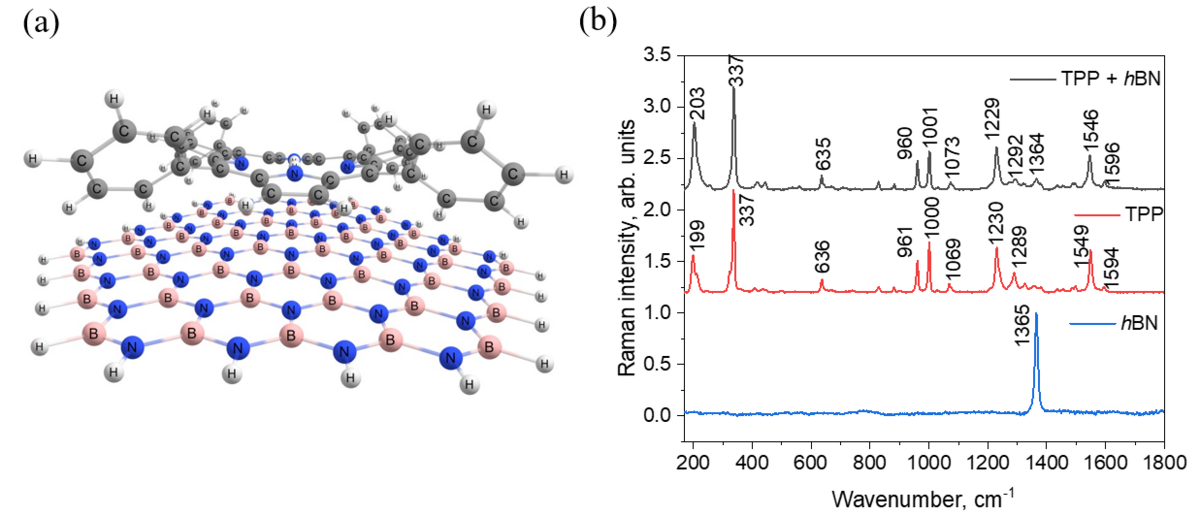
This study explores the formation of a weak van der Waals (vdW) complex between free-base meso-Tetraphenylporphyrin (TPP; molecular formula is C\(_{44}\)H\(_{30}\)N\(_{4}\)) and hexagonal boron nitride (hBN) (see Fig 1, a) through Raman (Fig. 1, b), FTIR, steady-state and time-resolved fluorescence. We observe red shifts (avg. 4 cm⁻¹) in the TPP Raman lines corresponding to macrocycle vibrations and blue shifts (avg. 3 cm⁻¹) in those corresponding to phenyl rings. These experimental results are confirmed by density functional theory calculations using all-electron Gaussian-type basis sets with dispersion correction (to take vdW interactions into account) included in the BPW91+d exchange-correlation functional. Additionally, both steady-state and time-resolved fluorescence exhibit changes that can be attributed to vdW interactions between TPP and hBN surface.