Hydrazide derivatives constitute an important part of medicinal chemistry - these compounds are mostly used as organic intermediates in the development of new biologically active molecules. Bound with various heterocyclic fragments, such systems exhibit antimicrobial, anticancer, antiviral, anti-inflammatory, antioxidant activity. Also, introducing hydrazone moiety to organic molecules improve their activity, due to its ability to form hydrogen bonds and create better conditions for interaction with molecular targets [1]. Among heterocyclic compounds, five-membered rings containing nitrogen atoms, such as pyrrole and pyrazole, are often found in medicinal molecules (for example, Sunitinib is used in carcinoma treatment, Celecoxib is anti-inflammatory agent) [2, 3].
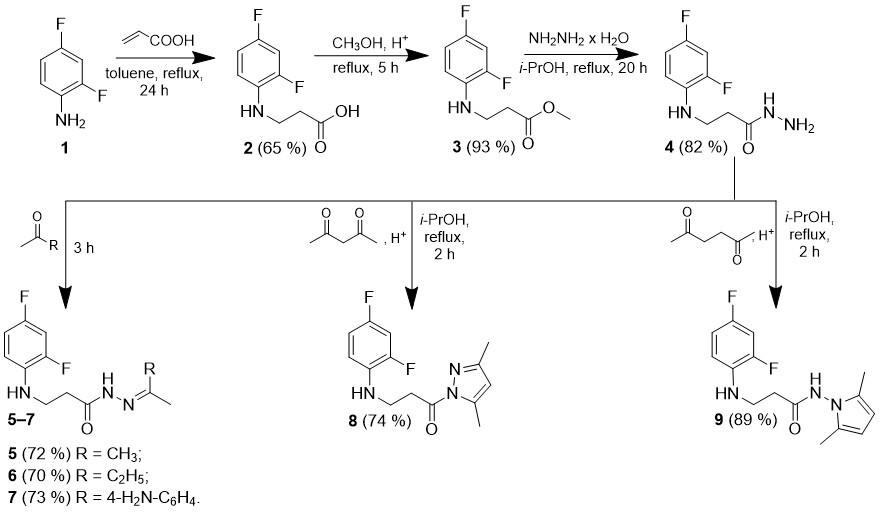
In the first step of the synthesis, 3-((2,4-difluorophenyl)amino)propanoic acid () was prepared by the reaction of 2,4-difluoroaniline () with acrylic acid in toluene. Later it was transformed into methyl 3-((2,4-difluorophenyl)amino)propanoate () by an esterification reaction. Propanehydrazide was synthesized by the reaction of hydrazine monohydrate in refluxing 2-propanol. In the further step of the synthesis, reactions with mono- and diketones were investigated. In the case of hydrazones and , acetone and ethyl methyl ketone acted as both reactant and solvent. The desired product was obtained by the reaction of propanehydrazide with 4-aminoacetophenone in 2-propanol at the boiling temperature of the mixture. In analogous reactions with diketones – 2,4-pentanedione and 2,5-hexanedione – cyclic compounds , were synthesized (Fig. 1).
The structure of the compounds has been proven by elemental analysis, \(^{1}\)H NMR, \(^{13}\)C NMR, FT-IR spectroscopy. Investigation of the antimicrobial and anticancer activity of the synthesized compounds are planned.