For more than fifty years, plastic materials have been the most practical and cost-effective choice for both commodity and specialty applications, thanks to their affordability, lightweight nature, corrosion resistance, wide availability, and excellent optical and mechanical properties [1]. The depletion of fossil fuels, along with rising environmental and economic concerns, has driven research toward renewable resource-based polymers with comparable or improved properties [2]. Photopolymerization is a light-induced process that initiates a chemical reaction, efficiently converting liquid resins into solid photopolymer forms, making it a promising and sustainable alternative for material transformation. This reaction is driven by photoinitiators within the resin, which absorb specific wavelengths of light and generate reactive species that start the polymerization process [3]. Photopolymerization is a fast, solvent-free process that minimizes volatile organic compound emissions and supports sustainability using renewable materials. It allows for precise spatial and temporal control, occurring only under light exposure and completing within seconds [4].
In this study, polymers were synthesized by the photopolymerization of resins containing natural oil-based monomers and glycerol-based comonomers, using ethyl-(2,4,6-trimethylbenzoyl)-phenylphosphinate as the photoinitiator.
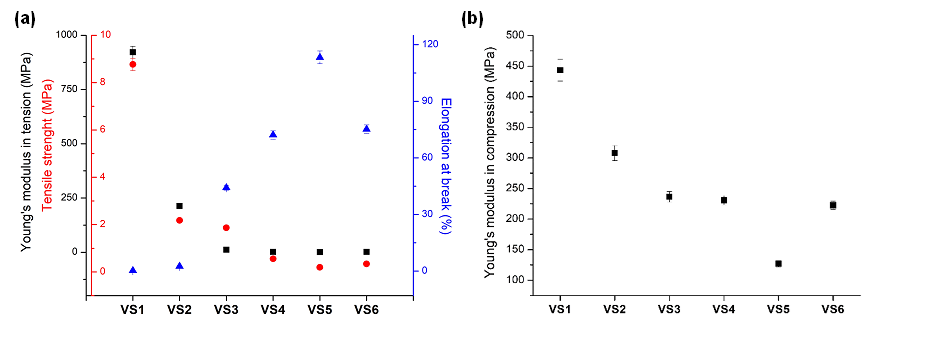
Using real-time photorheometry, the photocuring process was monitored, revealing the photocuring rate and the effect of monomer content on the resin’s properties. The chemical structure of the photopolymers was confirmed by Fourier transform infrared spectroscopy, Soxhlet extraction, and swelling tests. The mechanical properties of the photopolymers were investigated by tensile and compression tests. Fig. 1a illustrates the tensile test characteristics as a function of monomer content in the VS samples. This indicates that both the values of Young’s modulus and tensile strength decrease as the monomer content increases, while elongation at break increases. Fig. 1b presents the relationship between the compressive Young’s modulus and monomer content, showing a decrease in the values of Young’s modulus with higher monomer fragment content.
Results showed that variations in the initial resin composition affected the photocuring rate as well as the rheological and mechanical properties of the photopolymers.
Acknowledgement. This research was funded by the Research Council of Lithuania (project No. S-MIP-23-52).