
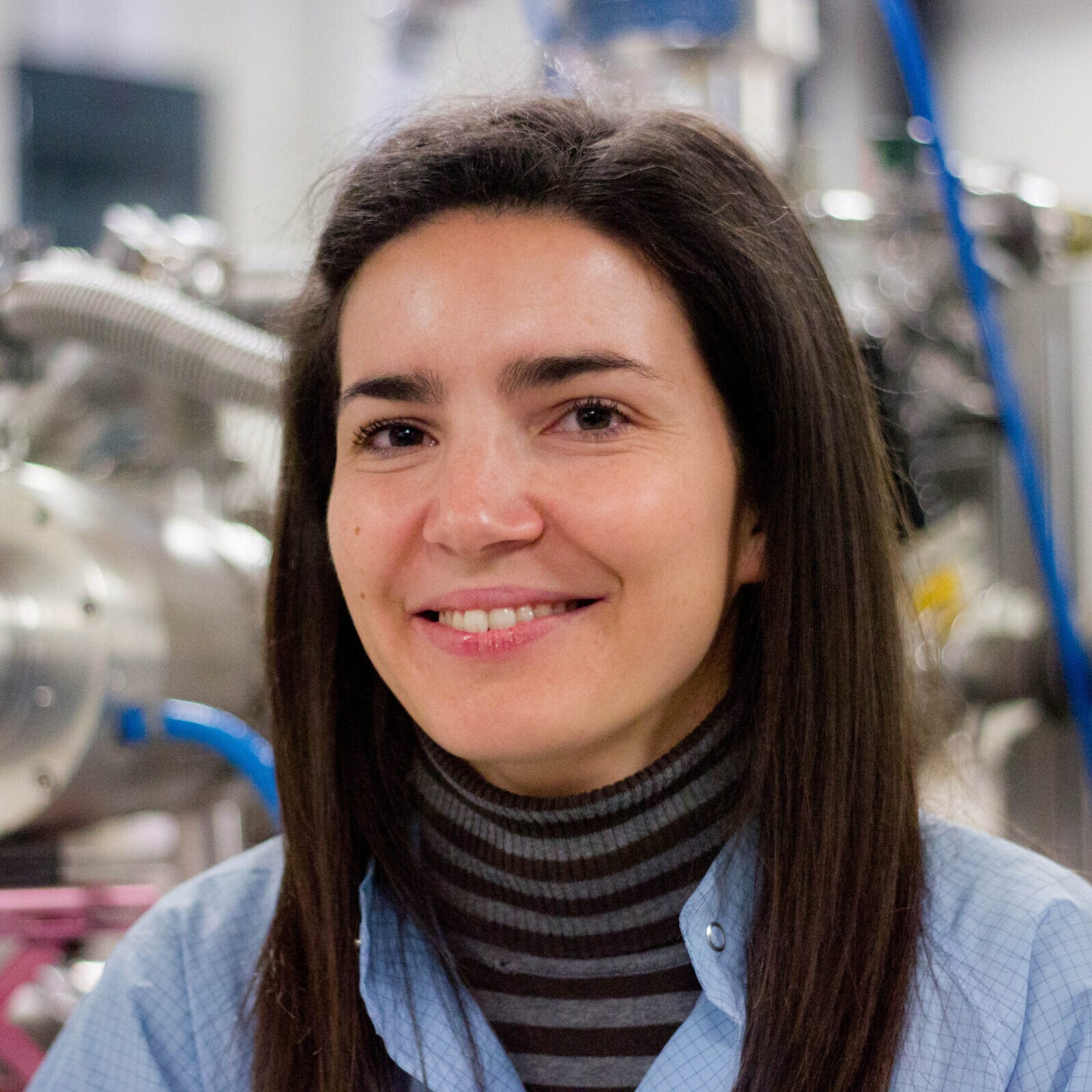
Prof. Francesca Calegari

University of Hamburg · DESY

ABOUT THE SPEAKER

.faist-bio { display: flow-root; color: #555555; font-size: 16px; line-height: 1.75; } .faist-bio .faist-photo { float: right; width: 380px; max-width: 48%; height: auto; margin: 8px 0 24px 30px; box-sizing: border-box; } .faist-bio p { margin: 0 0 18px; color: #555555; text-align: justify; line-height: 1.75; } @media screen and (max-width: 600px) { .faist-bio .faist-photo { float: none; display: block; width: 100%; max-width: 380px; margin: 0 auto 22px; } .faist-bio p { text-align: left; line-height: 1.7; margin-bottom: 16px; } }
Jérôme Faist

Francesca Calegari is a full professor of physics at the University of Hamburg and leads the Attosecond Science division at the Center for Free-Electron Laser Science (CFEL) at DESY, where she has been a lead scientist since 2016. Before moving to Hamburg, she worked as a staff researcher at IFN-CNR in Milan (2011–2016) and as an adjunct professor of physics at Politecnico di Milano (2013–2016), and in 2014 she spent time as a visiting scientist at the Max Planck Institute for the Structure and Dynamics of Matter in Hamburg.

Her research aims to follow, and ultimately control, the motion of electrons in real time in systems of growing complexity, from simple molecules to molecules of biological interest and nanostructured materials. To do this, her group develops table-top light sources with extreme time resolution, from a few femtoseconds down to attoseconds, covering wavelengths from the infrared to the ultraviolet and into the soft X-ray range. Attosecond technology is then used to understand the role of electron dynamics in the light-induced chemical changes that take place in biomolecules such as DNA and proteins.

Calegari is widely recognised for her contributions to attosecond technology and attosecond chemistry. Her distinctions include the ICO Prize and the Ernst Abbe Medal of the International Commission for Optics, two European Research Council grants, and a Fellowship of Optica. She chairs the PIER Executive Board, the strategic partnership between DESY and the University of Hamburg, and is a speaker of the Hamburg cluster of excellence Advanced Imaging of Matter.

This interview was recorded on 29 April 2026 at the Open Readings conference in Vilnius. She was interviewed by Prof. Dr. Mikas Vengris, Key Senior Researcher and Leader within the “High-intensity Laser Physics Group” at the Laser Research Centre.

THE INTERVIEW
Q How and when did you decide to choose physics as your field of work?

Ah, that’s a common question — how did you end up doing physics? Well, my first spark of interest in science started very early. When I was a kid, I got a microscope as a gift from my mom, who was a biologist. With it, I could look at microscopic things, like onion cells and such; I remember being really fascinated. On the other hand, I just remember this as an episode, something that triggered a lot of enthusiasm. It wasn’t as if I decided there and then that I necessarily had to go into physics. I was quite open to different things. Of course, I had a lot of interest in mathematics and in the natural sciences, and I was exploring different directions. I also talked to a few friends who happened to study physics. And I thought — it’s a very fascinating subject. And I decided to try this path.

Q Did your friends urge you to study physics?

Yes, but not just friends. At high school, I had very good teachers for mathematics and physics, who piqued my interest. And when you get good teachers, you get inspired, and they guide you towards your potential interests and capabilities. I realised I was quite good in physics. It was a starting point. And following my friends’ suggestions, I attended a couple of lectures at the university, just sitting down and listening to what the professor was saying, not really understanding everything, but, you know — getting exposed.

Q How did you find out about attosecond lasers?

When I was studying physics, there was no specific course in photonics, so I didn’t even know what an ultrafast laser was. Physics is broad and covers everything from quantum optics to thermodynamics. But at some point, I was taking a lab course for optics at the physics department. One of the tutors there was in contact with staff scientists at the Department of Physics of Politecnico di Milano. It’s an engineering school in Milan, quite famous for its strong school in photonics. It is one of the birthplaces of ultrafast science. The tutor advised me to visit, because there were PhD opportunities there. The first time I entered those laboratories and saw forests of optical mounts on the optical tables, all the colours of laser light, I was mesmerised: wow, that’s really, really cool. I was hooked.

Q Attosecond physics received a Nobel Prize a couple of years ago. What was your reaction?

On the one hand, I was quite surprised because I had thought that a discovery awarded a Nobel Prize must show a clear impact on society. And I thought attosecond science was still quite a young field, looking for practical applications. I thought: maybe that’s too early? But at the same time, I acknowledge the fact that even now high-energy photons, not just attosecond light pulses, are very important as a tool, for example in lithography and electronics manufacturing. So, I was a bit surprised at first, but extremely happy. I know the Nobel laureates very well; I was especially happy for Anne L’Huillier. Her prize was also a stroke of good luck for me, because I had actually invited her for a seminar in Hamburg before she was awarded the prize. And this was the first seminar she had scheduled right after her Nobel lecture. When I got the news about the prize, I immediately contacted her and said: congratulations, but are you still coming to Hamburg? Being the nice person she is, she said: “Of course, I want to keep my commitment.” The seminar at DESY was the first ‘normal talk’ after the prize. I think that is where she experienced the ‘Nobel effect’ for the first time. When she came, we booked this large auditorium at DESY in Hamburg. It was completely full, people were everywhere: sitting on the stairs, standing in the corridors… Anne was completely overwhelmed, but she kept taking pictures with all the students who asked her for one — she was amazing!

I was very happy about the Nobel. It’s a strong push for our field, and we all benefit from the large number of interested researchers exploring it.

Q Where do you think this field is going to go now? For example, your lab is applying attosecond pulses to molecules. Until now, it was mostly noble gases or solids, so are molecules something new?

We are already taking up the challenge of applying a complex light source to complex systems. We want to extend attosecond studies to large molecular systems, and also to complex environments. We try to do this not just in the gas phase, but in liquids, which are a more realistic environment for molecules. It is a big technical challenge, but it is also a motivation to demonstrate that the technology is now mature and can be used for advanced studies. There are still a lot of unknowns at these time scales. Theory is limited in giving us realistic predictions for complex systems, and experiments are very challenging. Our final goal is to develop novel protocols based on tailored attosecond sources to manipulate molecular properties by guiding them into specific chemical reaction pathways. There are also advanced studies on the quantum nature of light produced via extreme nonlinear optics, or novel approaches to combine strong-field physics and quantum optics for quantum sensing, charge and spin transport, and so on. Lots of exciting science ahead!

Q Let’s switch the topics a little: you are now a professor at Hamburg University and also a group leader at DESY Synchrotron/XFEL. At the early stages of their career, physicists are usually selected for being geeks, able to do very high-level technical work. However, as they progress, they are promoted to positions where they have to manage people — a task that is not typical for geeks. How are you managing this change? Is it difficult to adapt? What do you like better — the research or the research management?

I firmly belong to the category of scientists working in the lab. I actually miss that part very much, because I always loved lab work: developing setups, performing experiments. Discovering things. Real discoveries happen in the lab, not when you plan something. At the same time, I am happy to develop new skills. Managing a scientific group is very different from doing experiments in a lab. But this is how we grow: we learn and develop new skills. Of course, it also has to be something that you like, and I enjoy it. I try to keep a balance between research work and my growing managerial responsibilities. It’s not made easier by me being a woman. There are not so many female professors around, and I am more often asked to participate in committees, preside over something, and so on. But this also gives more opportunities. While having an impact on decision-making at the national and international level, I am trying to stay very close to the science that is done in my group.

Q How hard is this pile of responsibilities on your family life?

Well, it is hard, as in many other lines of work that demand managerial responsibilities. I have a family, a son, and — importantly — a husband who is my strongest supporter. I would say that is key. All alone, it would be nearly impossible to combine family and all the commitments I have.

Q Having a family is usually a two-person job?

That’s very important. My usual advice to female scientists is: choose a good partner with whom you can (and want to) share the load. My husband and I both have managerial-level jobs. We’re both very busy, but we ask each other for help and try to organise our life in a way that allows us to share the chores, the travels, and so on. I think we are quite well organised, but, of course, it’s a challenge.

It is also very important that institutions provide support for people with families, making sure that maternity or parental leave does not result in the person being left behind, with their opportunities taken by others. And I have to say that the job of a professor does provide a lot of flexibility. I have a lot of work, but it’s flexible. It is much less so for my husband, who works at a company.

Q What is your advice to the young scientists here at the Open Readings conference?

My first advice is, of course: follow your passion. Such conferences are a great opportunity to be exposed to different topics. You can meet the lecturers and hear talks from so many different fields. You can find something you love doing. When you do, follow it, no matter what the current trends and circumstances are worldwide. Nothing is predictable in terms of what the best job or the best choice of field is. I think passion is what drives you as a scientist or a person in general. That is my primary advice. In addition, if you choose to start a path in science and go for a PhD, carefully pick a very good supervisor, somebody you see as a role model.

Q For the second time, you advise to carefully pick the people around you: first, a good partner, now, a good supervisor. Is there a pattern?

People are very important. I like many topics in physics, and as a physicist I’m often excited by so many different things. It is really by chance, and by meeting the right people, that I ended up working in attosecond science. It could have been something else, because almost everything can be interesting. Therefore, your choices must be at least as much about the inspiring people as they are about the inspiring topic you work on.