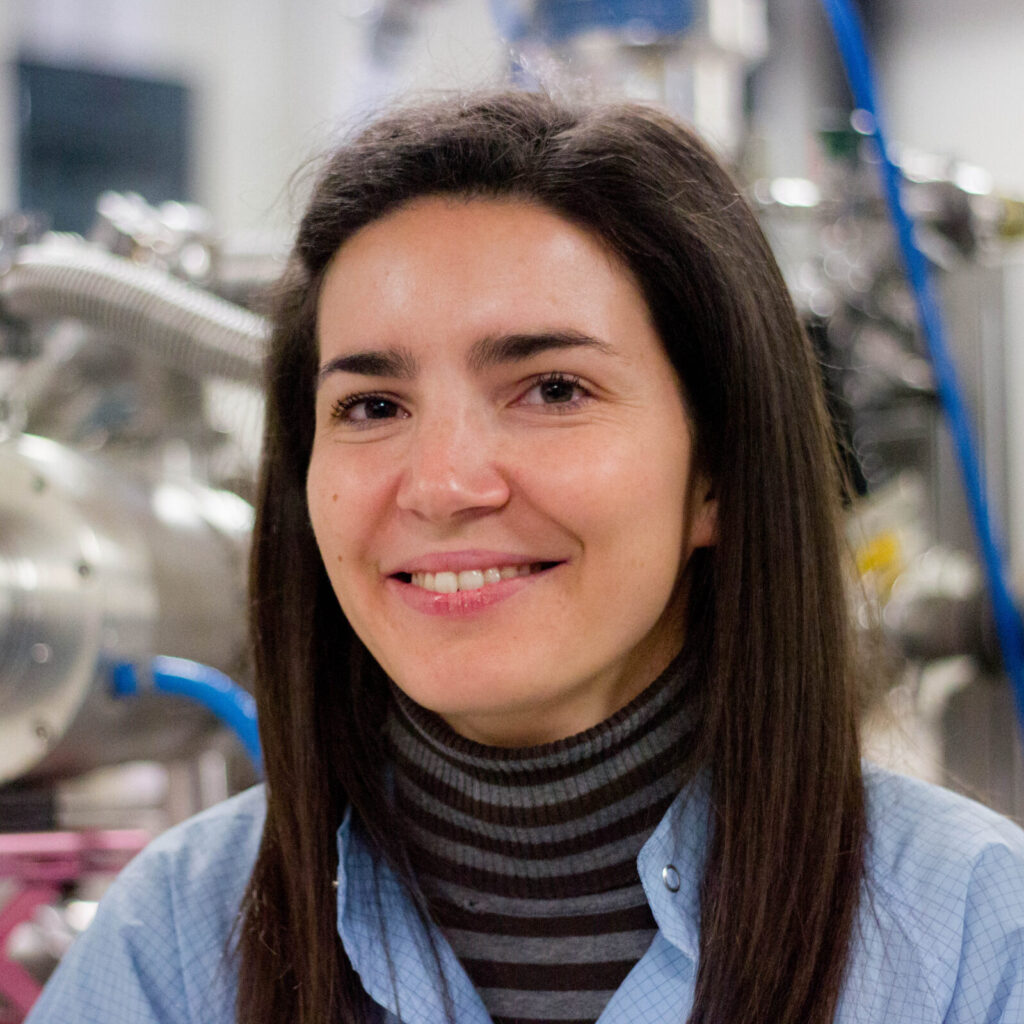

Francesca Calegari is an Italian physicist internationally recognized for her pioneering contributions to attosecond science and ultrafast spectroscopy. She leads the Attosecond Science Division at the Center for Free-Electron Laser Science (CFEL) at DESY in Hamburg and is a Professor of Physics at the University of Hamburg. Her scientific excellence has been acknowledged through numerous distinctions, including the International Commission for Optics (ICO) Prize, the Ernst Abbe Medal, the Zdenek Herman Molecule Young Scientist Prize, and election as a Fellow of Optica.
Calegari completed her studies in physics at the University of Milan and earned her Ph.D. from the Polytechnic University of Milan. She subsequently carried out postdoctoral research at the Istituto Nazionale per la Fisica della Materia and later returned to the Polytechnic University of Milan. In 2012, Calegari joined the Institute for Photonics and Nanotechnologies of the National Research council in Milan, simultaneously taking on a teaching role at the Polytechnic University of Milan. Her transition to DESY in 2016 marked the beginning of a major research program in attosecond science, which Calegari now leads. At the same time, she holds a professorship at the University of Hamburg and serves as chair of the PIER Executive Board – the central strategic partnership between DESY and the University of Hamburg.
Her research focuses on tracking – and controlling in real time – the electron dynamics that underline chemical and biological transformations. The research team under Caligari’s direction develops state-of-the-art table-top light sources that deliver pulses from the femtosecond to the attosecond regime and cover wavelengths ranging from the infrared to the soft X-ray domain. These tools enable fundamental investigations into photo-induced processes in systems of increasing complexity, from simple molecules to DNA, proteins, and functional nanomaterials. By combining attosecond spectroscopy with time-resolved X-ray diffraction at free-electron lasers facilities, Caligari’s work provides a powerful framework for unveiling ultrafast mechanisms central to photochemistry, photobiology, and artificial light-harvesting technologies.
Tracing Electron Dynamics in Molecules: Novel Approaches for Attosecond Chemistry
The Nobel Prize in Physics awarded in 2023 underscored the importance of attosecond light sources, which now grant us access into the electron time scale within matter. This advancement has paved the way for the emergence of attochemistry, a novel field aiming at manipulating chemical reactivity by steering the electron dynamics in molecules.
In this presentation, I will first give an overview of our latest achievements in producing remarkably short light pulses across both ultraviolet (UV) and soft X-ray spectral ranges. Additionally, I will highlight a variety of applications for these ultrashort light transients, such as the real-time observation of ultrafast charge migration and dissociative dynamics in photoexcited molecules. A key focus will be on our novel approach to instigating well-controlled charge migration in chiral neutral molecules, which represents a significant step toward achieving charge-directed reactivity—the ultimate objective of attochemistry.