Prokaryotic toxin-antitoxin systems (TA) are composed of a toxin, capable of interfering with key cellular processes, and its neutralizing antidote, the antitoxin.
Here, we focus on the HEPN-MNT TA system encoded in the vicinity of a I-D CRISPR-Cas system in cyanobacterium Aphanizomenon flos-aquae. MNT stands for minimal nucleotidyltransferase, while HEPN represents a group of higher eukaryotes and prokaryotes binding domain-proteins, mostly known as active RNases [1],[2]. We showed that HEPN toxin acts as an RNase with an unusual target specificity and cleaves off 4 nt from the 3'-end in a subset of tRNAs, thereby interfering with translation [3].
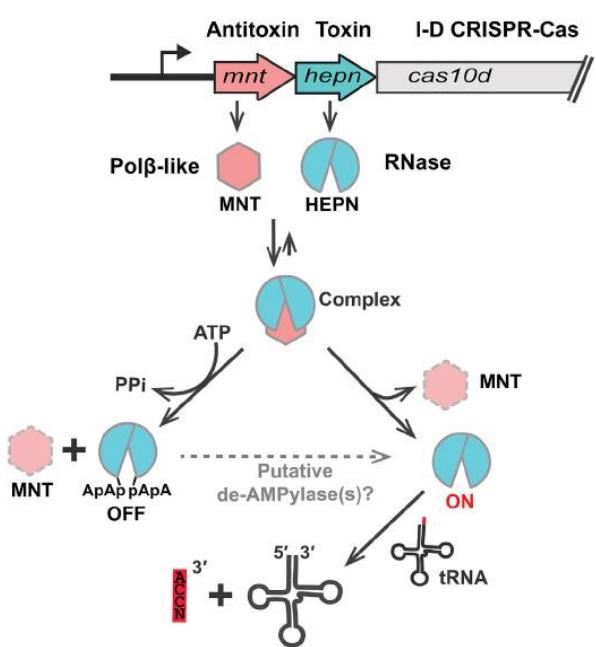
Moreover, we found that the MNT antitoxin inhibits HEPN RNase through enzymatic reaction. MNT performs covalent di-AMPylation (diadenylation) of a conserved tyrosine Y109 residue in the active site loop of HEPN toxin. Furthermore, we present crystallographic snapshots of the di-AMPylation reaction at different stages that explain the mechanism of HEPN RNase inactivation. Finally, we propose that HEPN-MNT system functions as a primitive cellular ATP sensor which monitors ATP homeostasis and at low ATP levels releases active HEPN toxin [3].
Fig. 1. Proposed mechanism of action of A. flos-aquae HEPN-MNT toxin-antitoxin system. After translation HEPN and MNT form a toxin-antitoxin (TA) complex. Under normal cellular ATP concentrations, MNT antitoxin di-AMPylates HEPN in the complex resulting in RNase inactivation and TA complex dissociation; released relatively unstable MNT is likely degraded. At low ATP levels caused by phage infection or other stress conditions that change ATP homeostasis, active HEPN RNase remains unmodified and may escape from the complex. Resultant cleavage of 4 nt from the tRNA 3'-end abolishes aminoacylation and disrupts translation. Alternatively, di-AMPylated HEPN RNase may be reactivated by as yet unknown cellular de-AMPylase(s).
[1] V. Anantharaman, KS. Makarova, AM. Burroughs, EV. Koonin, L. Aravind, Comprehensive analysis of the HEPN superfamily: identification of novel roles in intra-genomic conflicts, defense, pathogenesis and RNA processing. Biol Direct. 2013 Jun 15;8:15.doi: 10.1186/1745-6150-8-15.
[2] L. Aravind, EV. Koonin, DNA polymerase beta-like nucleotidyltransferase superfamily identification of three new families, classification and evolutionary history. Nucleic Acids Res. 1999 Apr 1;27(7):1609-18. doi: 10.1093/nar/27.7.1609.
[3] I. Songailiene, J. Juozapaitis, G.Tamulaitiene, A.Ruksenaite, S. Sulcius, G. Sasnauskas, Č. Venclovas and V. Siksnys, HEPN-MNT Toxin-Antitoxin System: The HEPN Ribonuclease Is Neutralized by OligoAMPylation. Mol Cell. 2020 Dec 17;80(6):955-970.e7. doi: 10.1016/j.molcel.2020.11.034.