
In this work we are using nitrogen–vacancy (NV) centers (Fig. 1 Left) in diamond to measure the vector [1] (magnitude and direction) of a magnetic field.
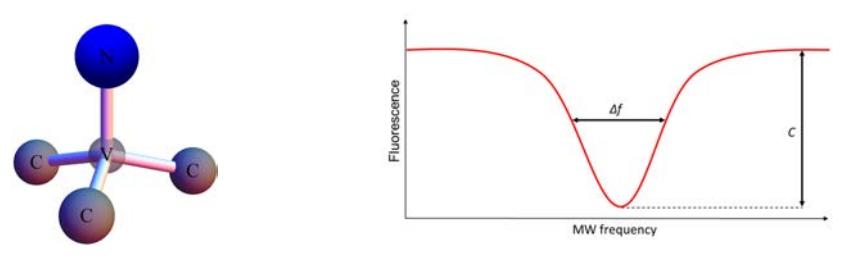
Fig. 1. Left: NV center, a $C_{3\nu}$ symmetric structure in a diamond crystal carbon lattice consisting of a carbon atom substituting nitrogen atom and a lattice vacancy adjacent to it. Right: Continuous wave ODMR magnetic field measurement sensitivity.
The sensitivity of a magnetic field measurement [2] can be estimated by the following relation:
$$\eta_{sensitivity} \approx \frac{\Delta f}{C\sqrt{N_P}}.\tag{1}$$The main parameters are $\Delta f$ - the full width of half maximum (FWHM), C - the optically detected magnetic resonance (ODMR) contrast, $N_P$ - the number of received photons per second (see Fig. 1 Right).
This work is focused on creating a compact magnetometer prototype device (with a magnetic field sensitivity on the order of $100 \text{ pT/Hz}^{1/2}$) as a part of a feasibility study project with the European Space Agency (see Fig. 2).
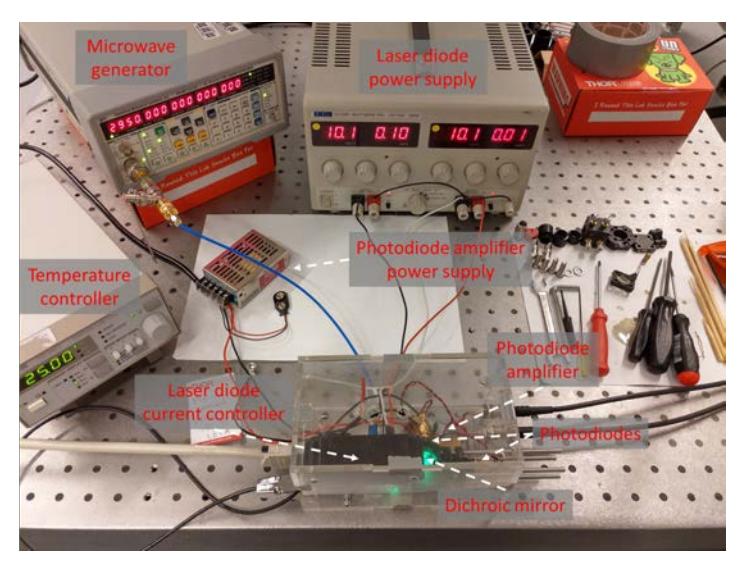
Fig. 2. Experimental setup showing a compact optical system design (laser excitation, fluorescence collection and microwave delivery) encased in a small volume.