
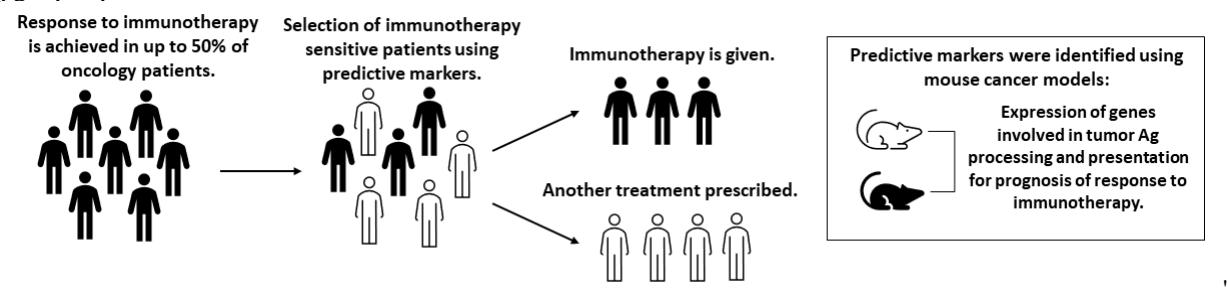
Immunotherapy is a promising cancer treatment that stimulates patient's immune system to fight against tumor. However, the response to cancer immunotherapy is only achieved in a small subset of patients (Fig. 1). Recent studies showed that unequal response to immunotherapy might be governed by tumor immune characteristics. Classification of patients by tumor immune properties in order to individualize immunotherapy is not widely used in the clinics, basically due to the lack of proper molecular markers. The aim of our study was to find two immunologically distinct murine tumor models and molecular markers for their stratification and prediction of response to treatment with dendritic cell vaccines and anti-PD-1.
C57BL/6 syngeneic glioma GL261 and lung carcinoma LLC1 cells were chosen for comprehensive investigation of immunological properties. GL261 and LLC1 cells were assessed by their ability to process and present tumor antigens (Ag) and the general nature of developing anti-tumor immune response. For this reason MHC I and PD-L1 expression was measured on GL261 and LLC1 cells surface. Also in collected primary tumor samples immune cell infiltration, expression of immune-related genes and genes involved in Ag processing and presentation were evaluated. These studies were followed by murine dendritic cell vaccines (DCV) and anti-PD-1 efficacy analysis in the treatment of mice with subcutaneously induced GL261 or LLC1 tumors. DCV were generated from murine bone marrow cells by differentiating with GM-CSF + IL-4 cytokines for 7 days [1] and maturing with LLC1 or GL261 cell lysate and E.coli lipopolysaccharide. Mice response to DCV and anti-PD-1 treatment was assessed by tumor size, changes in immune cell infiltration and expression of immune-related genes. All experimental protocols were approved by the local Institutional Animal Care Committee.
Our study showed that GL261 and LLC1 tumors possess different immune properties. The largest differences between these tumors were observed when assessing their ability to process and present tumor Ag. Significant decrease in the expression of genes involved in this process (such as Tap1, Tap2, Psmb8, Psmb9, Psmb10, Erap1, Irf2) were observed in LLC1 tumors. Impaired Ag processing and presentation mechanism in LLC1 cells resulted in low tumor immunogenicity, leading to the absence of effective anti-cancer immune response. By contrast in GL261 cells Ag processing and presentation mechanism was not altered, making them immunogenic and resulting in formation of anti-tumor immune reaction. Differences were also seen then treating tumors with DCV or anti-PD-1, there they effectively slowed GL261 development and almost had no effect for LLC1 tumors.
Changes in Ag processing and presentation mechanism might result in tumor insensitivity to dendritic cell vaccines and anti-PD-1 therapy. Therefore, expression evaluation of genes involved in Ag processing and presentation pathway (Psmb8, Psmb9, Psmb10, Tap1, Tap2, Erap1, Irf2) might help to stratify primary untreated murine tumors and predict their response to dendritic cell vaccines and anti-PD-1 treatment.