
In present work we compare conditions of spatio-temporal localization of terawatt femtosecond vortex (doughnut) and vortex-less (Gaussian) laser pulsed beams in Kerr media and formation of light bullets. Due to dozens of different applications of light bullets (LB) such as remote sensing of atmosphere, lightning control, high harmonic generation, astronomy, material processing, lithography and so on this activity field draw attention of researchers. As is known, in Kerr media the filamentation makes possible the spatial and temporal compression of pulses. The filament is a self-organized structure formed through the competition of underlying processes such as, for example, diffraction, Kerr nonlinearity, plasma photoinduced via multiphoton absorption or tunnel mechanisms, etc. Under anomalous group velocity dispersion (GVD) one of filamentation regimes may be realized, i.e. LB generation. As shown in experiment [1], the stability of the LB is due to their polychromatic Bessel-like structure consisting of a sharply localized high-intensity core and a weak, delocalized low-intensity periphery, which balances energy losses in the central core.
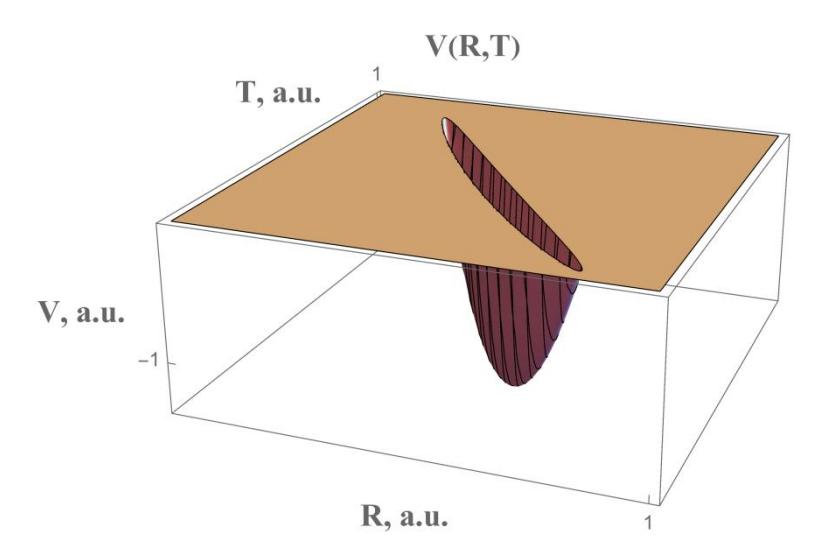
The system of nonlinear Schrödinger equation for the complex envelope of the electric field and kinetic equation for the electron plasma density is exploited. The Hamiltonian deduced on the base of this equation in approximation of negligible dissipation allowed us to obtain a potential function (Fig. 1). In the frame of two-scale variation approach the system of motion equations for both temporal T(z) and spatial R(z) beam radii was found. The solution of this system allowed to define the stability regions for LB. Solutions of the above equation system have been analyzed in broad spectral range of the anomalous GVD for fused silica and other Kerr solids at different values for topological charge m (0,1,2,3,4) and various ratios of input pulse power to critical one for self-focusing $\alpha$ >10. Under suggestion that the multi-photon ionization mechanism is dominated, we deduced the expressions for stationary values T0 and R0 corresponding to the minimum of the potential function V(R,T) and estimated their values in dependence on medium and radiation parameters. The stability is originated from the complete balance of all underlying processes accompanying the pulsed beam spreading. For vortex beams the following threshold dependence of their possible input power on m is revealed: $\alpha > 2m/0.093$. Only pulsed beams obeying this condition may propagate in vortex LB regime. The Gaussian-type LBs are free of such conditions.
We show for the case of the initial spatial radius and duration of the pulsed beam are detuned from their stationary values R0 and T0, the possible scenarios of their behavior under the LB propagation obey the dynamics of two coupled oscillators. So, the LB propagation is accompanied by oscillations of spatial and temporal radii. Furthermore, they may oscillate in phase or in antiphase. The frequency of the "in-phase" oscillations is less than for the antiphase oscillation frequency.