
In the recent years terahertz (THz) wave that represents electromagnetic radiation that ranges in frequency from 0.1 THz to 10 THz has drawn a special attention due to its unique properties [1] and a wide applicability in areas of spectroscopy, biological imaging, detection of hazardous materials, security screening, etc. A high demand for terahertz radiation emitting devices increased the development of new efficient sources. We present a method of THz frequency radiation generation from air plasma induced using bichromatic femtosecond laser pulses. Using this method the order of magnitude of generation efficiency is only 10-5 but on the other hand it is impossible to damage our source medium since ambient air is used so laser pump power is not the limiting factor. In this research we focused on optimisation of THz generation efficiency by varying the relative pump pulse timing, pulse energy and polarisations of the pump waves.
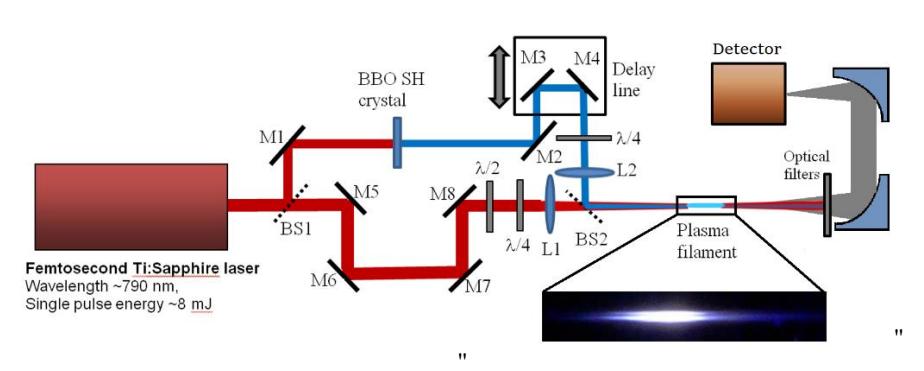
In our experiment we used a Ti:Sapphire laser system (Legend elite duo HE+, Coherent Inc.) delivering 43 fs pulses with repetition rate of 1 kHz, central wavelength of 795 nm and maximal pulse energy of 8 mJ. First, the laser beam was split with the help of a thin beam splitter. In one of the two beams a second harmonic (SH) was generated in a BBO crystal, while another laser beam was left as fundamental harmonic (FH). Quarter-wave plates were used on both beams for transforming pump wave polarizations to circular in order to increase THz generation efficiency [2]. SH radiation was filtered out from the FH and passed on to the focusing lens through dielectric mirrors of delay line. Two different lenses were used to focus both pump beams because of their different wavelengths and pulse energies (maximal pulse energies were 0.4 and 1.4 mJ for the SH and FH, respectively). Then both focused beams were concentrically overlapped in time and space using the delay line and a dichroic beam splitter. Then at proper pump pulse energies (up to 0.1 mJ), we have detected THz radiation that is emitted from plasma filament formed in air. THz radiation was filtered out from visible light and pump using silicon filters and then using parabolic mirrors directed to either pyroelectric detector or a microbolometric thermal camera.
It was found that increasing power of SH beam decreases the optimal relative delay value of SH pulses with respect to FH pulses. On the other hand, when FH power was increased a similar process occurred but it was much weaker due to lower FH pulse energy. Such dependence of delay values could be explained by the fact that during propagation, trailing part of the pulse is scattered more in the plasma created by the frontal part of the same pulse. Thus, focused pump pulses of the higher energy in air moves faster than these of lower energy. Therefore, the most efficient generation of THz radiation was observed when the relative timing of two pump pulses was adjusted according to the energies of these pulses.
The presented results could be useful in optimizing nonlinear optical processes, such as generation of terahertz radiation [3], as well as parametric four-wave mixing and generation [4], etc., whenever the bichromatic pump beams are used.