
Alginate is a naturally occurring polysaccharide obtained from cell walls of brown seaweeds. It consists of repeating β-D-mannuronic acid (M) and α-L-guluronic acid (G) residues linked as homopolymeric blocks or randomly. It is able to form hydrogel in the presence of water. In response to divalent cations (e.g., Ca2+, Ba2+, Fe2+, Mg2+ and Al3+) alginate cross-links. The amount of these cations determines the mechanical properties and the maximum water absorption capacity [1].
Alginate hydrogel is often used in the biomedical field, due to its biological activity, biocompatibility with tissues, biodegradability and lack of toxicity. Therefore, this type of hydrogel is excellent for applications in tissue engineering, wound treatment and regenerative medicine [2]. Furthermore, this soft material possesses the ability to undergo hydrolysis depending on pH, time and temperature. The swelling property of hydrogel and osmotic pressure gradient are important factors during the design of drug delivery systems (DDSs) for the controlled release of an active substance. These determinants directly influence the diffusion of drugs from the gel to the surrounding environment [3, 4].
A drug carrier administered orally would encounter various environments during its transit, including stomach, which has acidic conditions (pH about 1-2). Most of the substances are digested at this level. However, if the drug delivery system is desired to bypass the stomach and deliver the drug into the small intestine, where the environment is alkaline, alginate is the best material for this application. Alginate in the acidic environment does not swell. Therefore, to evaluate the effect of different media (aqueous solution with hydrochloric acid at pH 2 and aqueous solution with sodium hydroxide at pH 10) on the swellability of alginate hydrogel a comparative study was carried out [3, 4].
Alginate hydrogel (alginate, Sigma-Aldrich, Saint Louis, USA) was prepared by cross-linking with calcium chloride (CaCl2, Avantor Performance Materials Poland S.A., Gliwice, Poland) at concentrations of 0.1M, 0.5M and 1M, at different times (5 min, 15 min, 30 min and 60 min). The samples were immersed in different solutions (pH 2 and pH 10) at 21.7 °C and their weight was analyzed after a specific time (as shown in Figure 1).
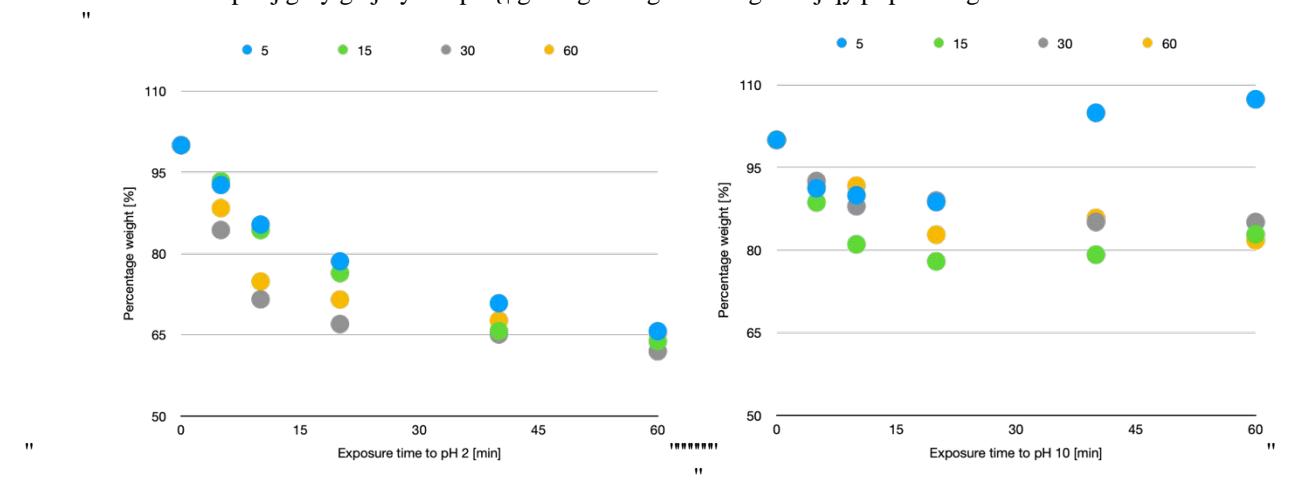
The aim of the present work is to compare and select the appropriate concentration of cross-linking agent for alginate as a future drug carrier material. The selection of these parameters (concentration of cross-linker and duration of cross-linking) is important to optimize the active substance release at a specific location in the gastrointestinal tract. Conducted research enables to determine the effect of the cross-linking factor on swelling properties of alginate hydrogel in different pH of media, thereby it would be beneficial in oral DDS design for controlled drug release.