
Nuclear Sirtuin-1 or SIRT-1 is a member of the family of NAD+ dependent protein deacetylase. Previous studies have showed that SIRT-1 is involved in processes related to programed cell death mechanisms, cell aging, it also can activate tumor suppressor genes, maintain energy metabolic hemostasis, and can reverse innate and adaptive immune tolerance [1,2]. Last researches pointed out perspectives to SIRT-1 in application to treat prion-mediated neurodegeneration, cancer, obesity-associated metabolic decreases, cardiac aging and stress [3]. Moreover, it plays role in cellular senescence, inflammatory signaling in response to environmental stress, development and placental cell survival [3].
This research aimed to investigate the role of SIRT-1 in the modulation of immune cell death and survival. We examined biological effects on B- and T-cells death type and autophagy after activation or inhibition of SIRT-1 in vitro under oxidative stress.
For examination effects on cell death and survival, we isolated immune cells from the thymus and inguinal lymph nodes of Albino line mice, adult females weight 18-20 g. B- and T-cells cultivated with 20 μM resveratrol (specific activator of SIRT-1) or 5 mM nicotinamide (unspecific inhibitor of SIRT-1) in RPMI media with 100 μM H2O2 (oxidative stress factor) during 1 hour at 27°C in the natural atmosphere. Control groups cells cultivated in pure RPMI media for 1 hour at 27°C in a natural atmosphere. For detection of live, necrotic and apoptotic cells were used a combination of Propidium iodide and HOECHST dyes solution and fluorescent microscopy imaging (Fig. 1. A pic.) For detection autophagy (Fig.1. B pic. ), we used Monodansyl cadaverine dye solution and fluorescent microscopy imaging.
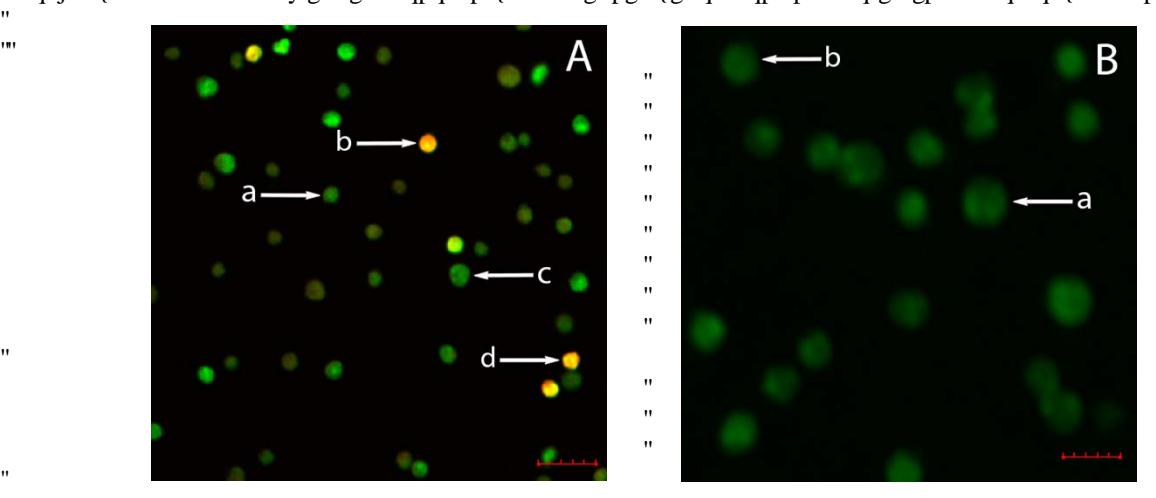
We showed in our research that SIRT-1 activation by resveratrol leads to increasing immune cells resistance to oxidative stress and promotes autophagy. For B-cells survival rate 10.3% increase and for T-cells 13.1% increase. In these groups also was observed increase of autophagy for B-cell up to 8.2% and T-cell up to 9%. Necrosis rate is decreased for B-cell and for T-cell to 14.2% and 11.5% in accordance. Apoptosis rates have a trend to increase for B- and T-cells. Inhibition of SIRT-1 by nicotinamide leads to less survival ability of immune cells and promotes increasing of apoptosis. For B-cells survival rate decreased up to 5.2% and for T-cells decreased up to 6.8%. Apoptosis rate is increased for B-cell and for T-cell to 3.3% and 4.8% in accordance. Necrosis rate for B-cells increases up to 3.5%. Also in this group decrease autophagy rate for B-cell up to 3.7% and T-cell up to 6.2%. We used Student's t-test for statistical analysis, p<0.05.
Conclusion: SIRT-1 activation increase cell resistance to oxidative stress in immune cells. Using resveratrol leads to increasing immune cells survival and rate of autophagy, at the same time it drives to decreasing necrosis rate. Inhibition of SIRT-1 by nicotinamide leads to less survival ability of immune cells and promotes increasing of apoptosis and decreasing of autophagy.