Triplet-triplet annihilation (TTA) mediated NIR-to-visible photon upconversion (UC) is a rapidly advancing field of photonics with numerous potential applications. [1] The most promising TTA-UC applications include photovoltaics, photocatalysis, night vision, targeted drug delivery and bio-imaging. [1-3] UC systems are typically composed of a sensitizer and an emitter. The sensitizer is responsible for absorption of low energy photons and triplet generation via intersystem crossing, whereas the emitter - for accumulation of triplets and TTA, which is followed by emission of higher energy photons. However, several challenges related to a lack of TTA emitters in NIR range, their tendency to aggregate and low UC quantum yield are yet to be overcome. From this point of view, diketopyrrolopyrrole (DPP) emitters seem to be an attractive alternative to a widely used rubrene [1] or perylene diimide [3].
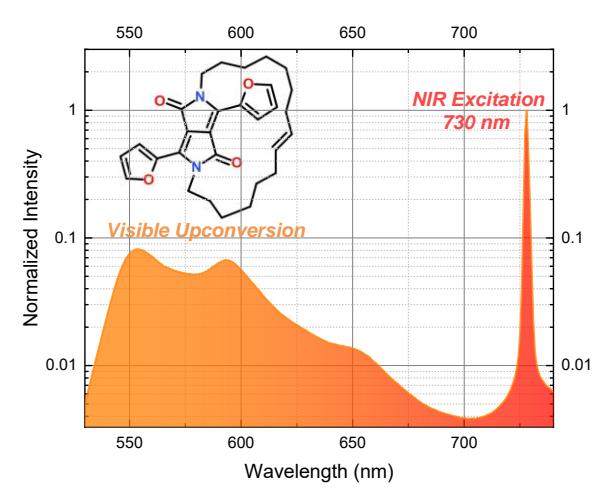
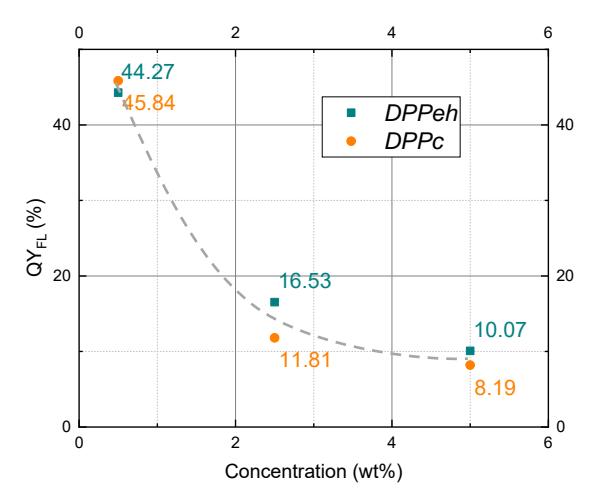
The work is focused on revealing the impact of different side-moieties of DPP compounds on the aggregation-caused emission quenching, and subsequently, UC performance. To this end, photophysical properties of ethylhexyl-substituted compound (DPPeh) as well as of alkyl chain strapped compound (DPPc) were thoroughly assessed. Essentially, the DPP derivatives expressed high FL quantum yield (91%) in the isolated form and demonstrated the feasibility for TTA in a solution. UC measurements of DPP solutions admixed with phthalocyanine (PdPc) sensitizer in oxygen-free atmosphere revealed NIR-to-vis upconversion with UC quantum yield of 2.9% (Fig. 1). Although the introduction of different side-moieties into DPP did not alter its aggregation noticeably (Fig. 2), the obtained efficient UC confirmed the potential of these derivatives for TTA-UC application.