
Clean and renewable energy sources currently are of great interest for many researchers, due to the ever-growing demand of energy and current reliance on fossil fuel consumption. Hydrogen gas (H2) is considered one of the cleanest energy sources available, which can be obtained by using noble metal electrocatalysts for water splitting. However, the scarcity and cost of noble metals is a hindrance to successful application of water splitting for hydrogen generation on an industrial scale [1]. Therefore, alternative electrocatalysts are thoroughly investigated, with molybdenum disulfide (MoS2) being recognized as a promising replacement for noble metal electrocatalysts [2].
In this study, nanoplatelet-shaped hybrid MoS2 films were fabricated onto anodized Ti substrates via hydrothermal synthesis from a solution consisting of thiourea, ammonium heptamolybdate and L-cysteine. Hydrothermal synthesis was carried out at 220 ± 2 °C for 5 to 10 h using a Teflon-lined steel autoclave.
SEM images of fabricated MoS2 nanostructures (Fig. 1a.) reveal that molybdenum disulfide films, synthesized both with and without L-cysteine possess a nanoplatelet morphology deposited onto the surface of titanium nanotubes (Fig 1a. Inset) formed by Ti anodizing, which is consistent with our previous findings. Electrocatalytic properties of hybrid MoS2 films were assessed by linear sweep voltammetry measurements in 0.5 mol/L H2SO4 using a three-electrode setup. From these cyclic voltammograms (Fig. 1b.), it can be seen that addition of L-cysteine to the synthesis solution leads to an increase of current density, reaching approximately 65 mA/cm2 at -0.35 V. Furthermore, hybrid MoS2 electrocatalysts synthesized with L-cysteine display much better electrocatalytic stability with the current density decreasing by ~8% after 2000 cycles, whereas samples without L-cysteine exhibit a decrease of about 70% of initial current density after just 250 cycles.
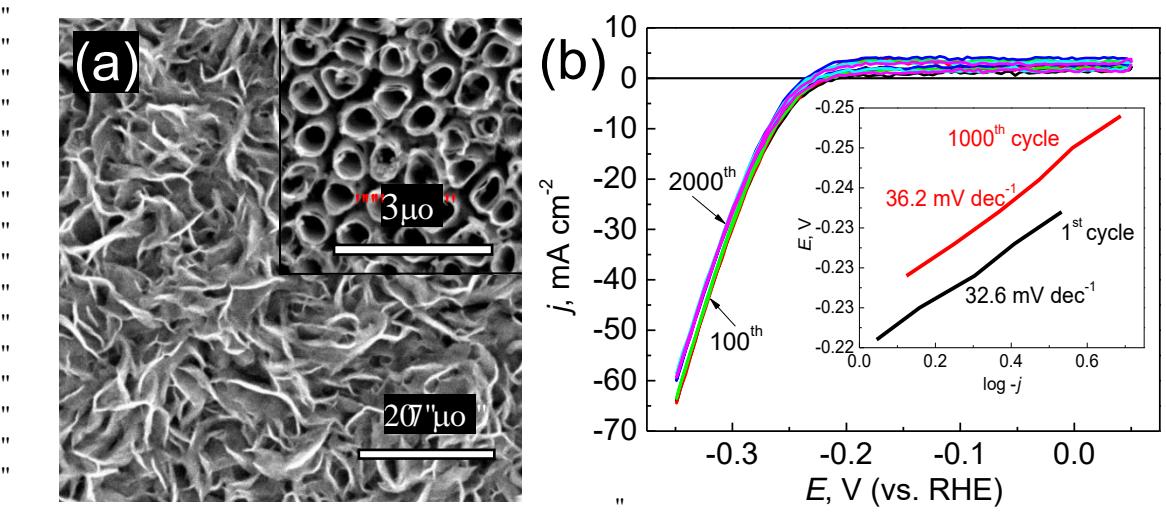
The Tafel slopes (Fig. 1b. Inset) of samples with L-cysteine were found to be close to that of Pt/C, which is considered an ideal HER electrocatalyst. XPS analysis suggests that HER stabilty and activity of MoS2/L-cysteine electrocatalysts increase are related to the formation of a 2D composite composed of a dominating metallic and highly active 1T-MoS2 and MoO2 phases interfaced with the semiconducting 2H-MoS2 and MoO3 phases. Additional research is to be undertaken in order to gain further insight on the influence of amino acids on the formation mechanism of hybrid MoS2 films.