
Over the last decade perovskite solar cells (PSCs) received large amount of attention from scientists and the efficiency of these devices was increased up to 25.5% [1]. Consequently, PSC became one of the most promising future photovoltaic technologies. At this moment, large effort is being made towards commercialization, by improving the long-term stability and finding the balance between the device performance and overall manufacturing costs. Large part of cost-effectiveness in PSC relies on the charge transporting materials, therefore, many researchers have focused their attention on development of optimal hole transporting materials (HTMs).
Inorganic semiconductors, such as transition metal oxides, copper or nickel derivatives offer beneficial physical and chemical properties. Among them, copper (I) thiocyanate (CuSCN) can be highlighted as one of the most promising HTMs, because of its low-cost, large bandgap (>3.5eV), optical transparency and relatively high hole mobility (up to 0.1 cm2V-1s-1). Furthermore, CuSCN is solution processable and its layer can be deposited even at low temperatures. These benefits make CuSCN perspective semiconductor for application not only for PSCs, but also in other optoelectronics, e.g. organic light-emitting diodes or CdTe solar cells. However, CuSCN is insoluble in most of widely used solvents, therefore current CuSCN solution processing technologies are limited to only a few solvents, such as ammonia solution or diethyl sulfide (DES). Both of them can damage perovskite layer, additionally DES has strong emetic effect, so its elimination would be advantageous, especially in larger scale application [2-4].
In this research, a series of different organometallic complexes were synthesized as CuSCN precursors to improve its deposition procedure. All synthesized compounds were obtained in one-step synthesis, purified by quick and inexpensive methods and most of them are characterized by relatively low thermal decomposition temperatures. These precursors thermally decompose to form CuSCN and volatile organic byproducts which evaporate during the layer formation step, as shown in Scheme 1.
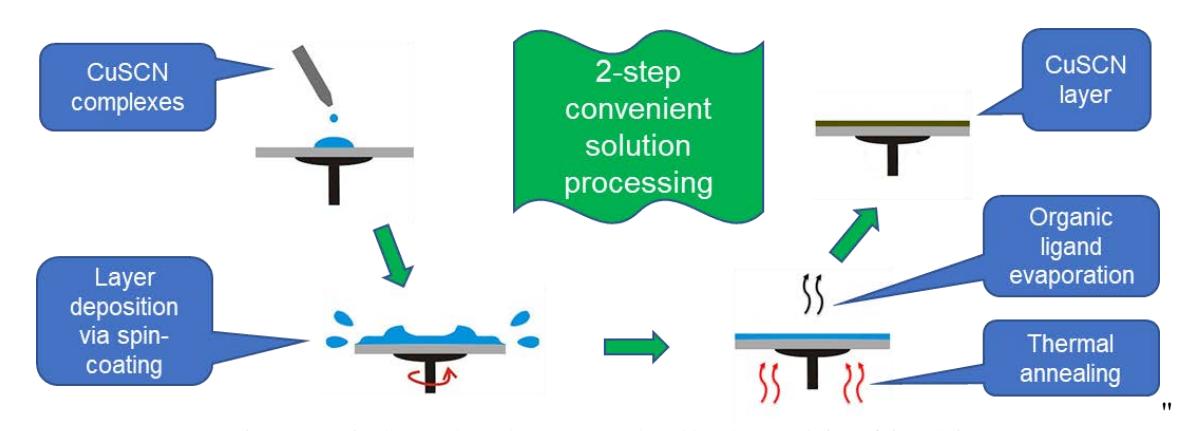
Large part of synthesized CuSCN complexes, investigated in this work, are soluble in dimethyl sulfoxide, which is considered as a green solvent and can be used as a replacement for DES. Moreover, several precursors have demonstrated solubility in other organic solvents such as chloroform and tetrahydrofuran, hence their usability can be expanded to various PSCs architectures, as well as other optoelectronics.