
Hydrogen synthesis through water electrolysis is strongly limited by the high overpotentials associated with the anodic oxygen evolution reaction (OER). One of the alternatives could be replacing oxygen evolution with the oxidation of a more readily oxidized species like alcohols [1]. Through recent years increased production of biodiesel of which glycerol is the main byproduct (10 wt%) increased glycerol's availability and made it a perfect candidate for the alternative anode reactions to value-added products [2].
High-entropy alloys (HEAs) are alloys that are formed by mixing comparatively large or even equal proportions of usually five elements. Due to the multiatomic composition a unique alloy structure, with various active binding sites and improved catalytical properties can be achieved [3]. For this research HEAs were obtained using aerosol-based spraying synthesis route and limited to a maximum of two noble metals in the structure. To find the best HEA for glycerol oxidation both elemental composition and elemental ratio in the alloy were varied consistently.
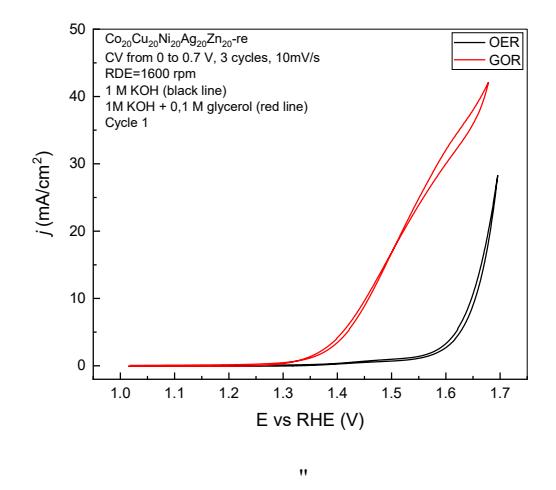
HEA suitability for glycerol electrooxidation was firstly investigated by evaluating its catalytical activity. It was done by performing potential cycling between 0 and 0.7 V, 10 mV/s, for 3 cycles in 1 M KOH and 0.1 M glycerol solution in 1 M KOH. For electrochemical measurements, a three-electrode system where the working electrode was modified with catalyst suspension was used. In pure electrolyte solution, oxygen evolution reaction was monitored and later compared to the alcohol oxidation reaction occurring in the glycerol solution by comparing the current density and overpotential values (Fig. 1). This way over 40 catalysts were scanned and their catalytical activity assessed.
Catalysts that demonstrated sufficiently high current densities and suitable overpotential values were further used to investigate their selectivity for glycerol oxidation. This was done using a closed system flow-through cell where glycerol and 1 M KOH solutions were used for the circulation in modified with catalyst working electrode and counter electrode compartments simultaneously. Compartments were separated using ion-exchange membrane. Samples of oxidized glycerol solution were taken at fixed time intervals through the time span of 48 h and analyzed using high performance liquid chromatography (HPLC).
Multiple selectivity measurements revealed that the main products of glycerol oxidation were lactic, oxalic, tartronic, formic, acetic, glycolic and glyceric acids. The influence of different elements and their ratio to the selectivity were also evaluated. It was noted that varying the composition of HEAs may lead to a higher selectivity towards particular product formation. This leads a promising way for future research where conversion of certain molecules can be easily shifted towards a desirable direction by ease manipulation of HEAs.