
Organosilicon compounds are rather attractive in the field of surface science. Cyclic hydrocarbon films have good surface adhesion properties which are mostly related to a $n$ electron orbital1. Substituting one carbon atom in the ring with a silicon atom enhances adhesion since it acts as hydrolytically sensitive center that can react with inorganic substrates such as glass to form stable covalent bonds2. 1-chloromethyl-1-fluorosilacyclohexane is a newly synthesized cyclic organic compound with unknown structural parameters and conformational diversity.
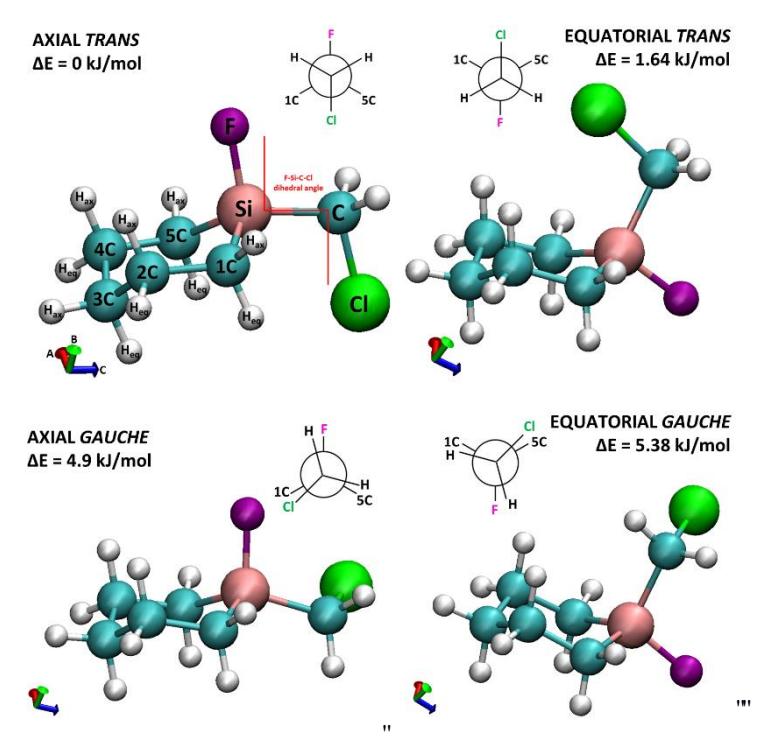
Several different vibrational spectroscopy methods were employed to analyze the properties of this molecule. Infrared and Raman spectra were recorded for the sample in liquid phase. Additionally, IR absorption spectra were registered in gaseous phase and as low temperature solid with the molecules isolated in argon and nitrogen matrices. In order to control thermodynamic equilibrium between the conformers hot nozzle technique was used during the deposition of the gaseous matrix mixture. DFT calculations were performed utilizing B3LYP functional and augmented Dunning correlation-consistent valence double zeta basis set. The 1-fluoro-1-chlormethyl-silacyclohexane molecule can reveal twelve conformations out of which the chair-axial-trans one has the lowest energy. However, there are also three two more chair type conformers that are stable enough to possibly be observed in experimental spectra.