One of the subclasses of metal-organic frameworks (MOFs) with very interesting physicochemical properties are metal-formates templated by ammonium ions. They are classified as hybrid organic-inorganic perovskites (HOIPs), because most of them adopt perovskite-like architecture, described by general formula AB(HCOO)3, where sites A and B and are occupied by an ammonium ion and metal ion (i.e. Mn2+, Co2+, Ni2+ or Zn2+), respectively [1].
Depending on their structure and crystal symmetry, there are known examples of formate HOIPs that exhibit luminescent, ferroelastic, ferroelectric, dielectric, magnetic or multiferroic properties. Our particular attention was caught by amines with varying number of methyl groups.
An increasing number of methyl groups affects the steric hindrance, order of hydrogen bonds and thus crystal structure and physicochemical parameters, such as phase transitions (PTs) temperatures or ferroic ordering. For example, manganese(II) hydrazinium formate, [Hy]Mn(HCOO)3, is a multiferroic material, which crystallizes in the orthorhombic Pna21 space group. At 355 K, it undergoes PT to the Pnma centrosymmetric phase [2]. The methylhydrazinium analogue, [MHy]Mn(HCOO)3, experiences two PTs upon cooling, i.e., at 310 K from dynamically disordered high-temperature (HT) R3c phase to the partially ordered room-temperature (RT) ferroelectric R3c phase and at 224 K to the P1 phase. The ferroelectric nature of the RT phase was confirmed by pyroelectric measurements [3]. It is worth emphasizing that the methylhydrazinium cation was recently shown to be an interesting agent that can be used as a templated cation or spacer in design of novel non-centrosymmetric 3D or 2D lead halide perovskites [4,5].
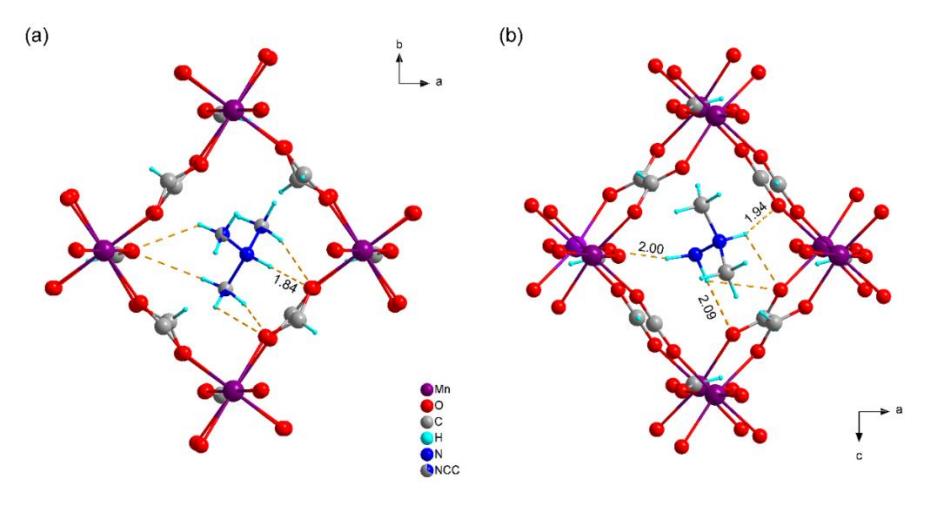
In view of the above, the 1,1-dimethylhydrazinium cation caught our huge attention. In presented work, synthesis and physicochemical properties of 1,1-dimethylhydrazinium analogue, [DMHy]Mn(HCOO)3 (Fig. 1.), are described and compared to results obtained for hydrazinium and methylhydrazinium analogues. The title compound has been investigated using methods of differential scanning calorimetry (DSC), Raman, infrared (IR) and UV-VIS spectroscopy, powder and single-crystal X-Ray diffraction (XRD), magnetic measurements and broadband dielectric spectroscopy (BDS).