Stretchable electronics refer to electronic devices and materials that have high elasticity, stretchability, and deformability. Unlike their conventional counterparts, stretchable electronics devices can usually be elongated by at least 10% without noticeable loss in conductivity and other functional properties [1]. Development of stretchable and elastic electrochromic materials can be used as a proof-of-concept technology for wearable displays. For example, small screens made from thousands of pixels built by stacking several layers, can display text or even images. Furthermore, by combining different electrochromic materials of red, green, and blue colors it is possible to make multicolor display [2].
The aim of this research was to develop a stretchable electrochromic composite based on elastomer material and conducting polymer poly(3,4-ethylenedioxythiophene) polystyrene sulfonate (PEDOT:PSS) and investigate its functional properties. Electrochromic stretchable films were prepared by mixing conducting polymer PEDOT:PSS with aqueous elastomer dispersion to obtain a homogenous composite. Functional elastomeric films were formed by solution casting in a mold filled with fixed amount of a mixture and dried at 60°C. Dilution by deionized water was used to achieve thickness control. All electrochemical measurements were performed in a custom made three electrode system where Ag/AgCl and platinum wire were used as reference and counter electrodes, respectively, while electrochromic stretchable films fixed on a glass substrate were used as working electrodes.
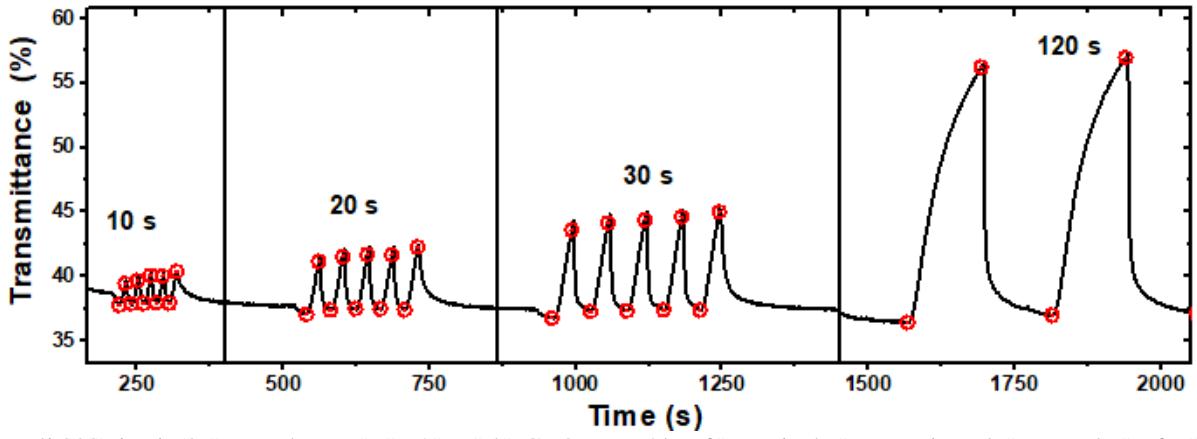
To evaluate electrochromic properties of the obtained composited chronoamperometric measurements were performed. The duration of a single switching cycle was 60 seconds, and the electrochemical potential was switched between -2 V and +1 V vs Ag/AgCl. During chronoamperometric test transmittance ($T%$) at maximum absorption wavelength 590 nm was recorded. Using acquired data absolute difference between neighboring peak values was calculated to obtain $\Delta T%$.
The optimization of chemical composition, thickness of the films, applied electrochemical potential and pulse duration (Fig. 1.), and temperature treatment were carried out to achieve the greatest change in optical transmittance. Stretchability, Young's modulus, and thickness of the EM were estimated based on theoretical calculations.