
Diclofenac is an anti-inflammatory drug with the highest acute toxicity among the non-steroidal anti-inflammatory drugs. Due to its extensive consumption, diclofenac has been detected in the samples of surface water such as rivers as well as wastewater treatment plants. Hence, the use of traditional mechanical and biological wastewater treatment technologies results in insufficient removal of this type of contaminant [1]. The aim of this work was to study the adsorption of diclofenac from water on cross-linked cationic starch.
Cross-linked cationic starch (CLCS) microgranular sorbent was obtained by the means of chemical modification of potato starch. CLCS was obtained by cross-linking potato starch with 0.1 mol/AGU (anhydroglucoside unit) of epichlorohydrin and cationization with 2,3-epoxypropyltrimethyammonium chloride by varying molar ratios of reagents. The starch derivatives with the degree of substitution of quaternary ammonium groups of 0.21 and 0.33 were synthesized. Sorbents granules were characterized by scanning electron microscopy, Fourier-transform infrared spectroscopy and thermogravimetric analysis.
The adsorption of diclofenac onto CLCS microgranules was investigated by employing the equilibrium adsorption method. The obtained isotherms of diclofenac adsorption on CLCS at 20 °C and diclofenac removal efficiency from water diagram are presented in Fig. 1A and Fig. 1B, respectively.
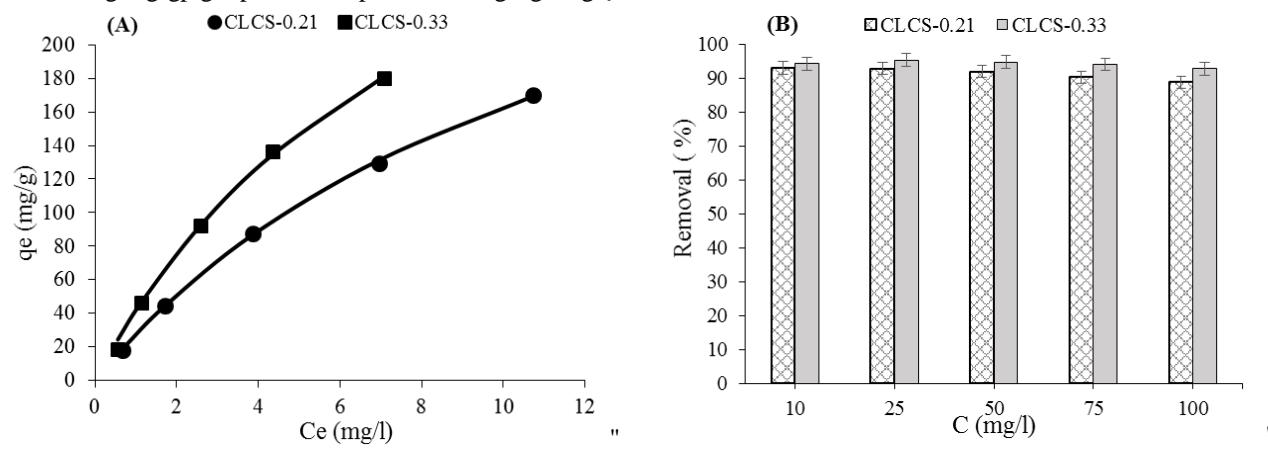
The Langmuir, Freundlich and Dubinin-Radushkevich adsorption models were used to describe the adsorption isotherms. According to the Langmuir adsorption model, the diclofenac molecules were adsorbed on the active centers i.e. quaternary ammonium groups of CLCS. The Langmuir sorption capacities were 406 and 365 mg/g when diclofenac was adsorbed onto CLCS-0.33 and CLCS-0.21, respectively (Table 1). The values of Freundlich constant $n_F$ and Dubinin-Radushkevich adsorption energy $E_{DR}$ indicated that conditions for diclofenac adsorption onto CLCS were unfavorable and the ion-exchange mechanism was predominant during adsorption.
| Sorbent | Langmuir model | Freundlich model | Dubinin-Radushkevich model | |||
|---|---|---|---|---|---|---|
| QL (mg/g) | R2 | nF | R2 | EDR (kJ/mol) | R2 | |
| CLCS-0.33 | 406 | 0.9972 | 1.33 | 0.9938 | 10.0 | 0.9968 |
| CLCS-0.21 | 365 | 0.9970 | 1.36 | 0.9947 | 9.1 | 0.9975 |
As can be seen from Fig 1B the removal of diclofenac varied from 93 to 94% and 89 to 93% when using different concentrations of CLCS-0.33 and CLCS-0.21 sorbents, respectively. The obtained results confirmed that CLCS is promising sorbent for the removal of pharmaceuticals contaminants containing anionic groups from aqueous medium.