
Tungsten (VI) oxide (WO3) is an n-type semiconductor which has been attracting much attention as photoanode for photoelectrochemical (PEC) water splitting as well as degradation of pollutants. WO3 is attractive due to its relatively low cost, chemical stability and ability to absorb visible light (band gap is 2.5 - 2.8 eV) [1][2]. It is well-known that the product of photoanodic reaction in the case of WO3 photoanodes depends largely on the composition of the electrolyte used. Valuable oxidizing reagents such as hypochlorite and persulfate can be produced photoelectrochemically on WO3 photoelectrode in chloride and sulfate solutions, respectively. In this study we compared the efficiency of the photoanodic processes taking place on WO3 electrode surface in 0.5 M H2SO4, 0.5 M NaCl and 0.5 M Na2SO4 electrolytes.
WO3 photoanodes were synthesized using sol-gel method and Na2WO4.2H2O as precursor. Five different reductants methanol, ethanol, propanol, isopropanol and butanol were used to deposit WO3 layers on conducting glass (FTO) substrate. The coatings were annealed at 400°C for 2 h in air atmosphere. The crystallographic structure and surface morphology of the calcined WO3 films was characterized by X-ray diffraction and scanning electron microscopy (SEM) techniques. Optical properties of the films were analyzed by means of photoluminescence spectroscopy. Photoelectrochemical behaviour of the samples was investigated using cyclic voltammetry, chronoamperometry under chopped illumination, electrochemical impedance spectroscopy. Photoelectrolysis experiments were performed in two electrode cell with Pt cathode. Iodometric and chromatometric titration methods were used to determine the amounts of photoelectrochemically produced ClO- and S2O82-, respectively, in order to evaluate faradaic efficiency (FE) of photoanodic reactions.
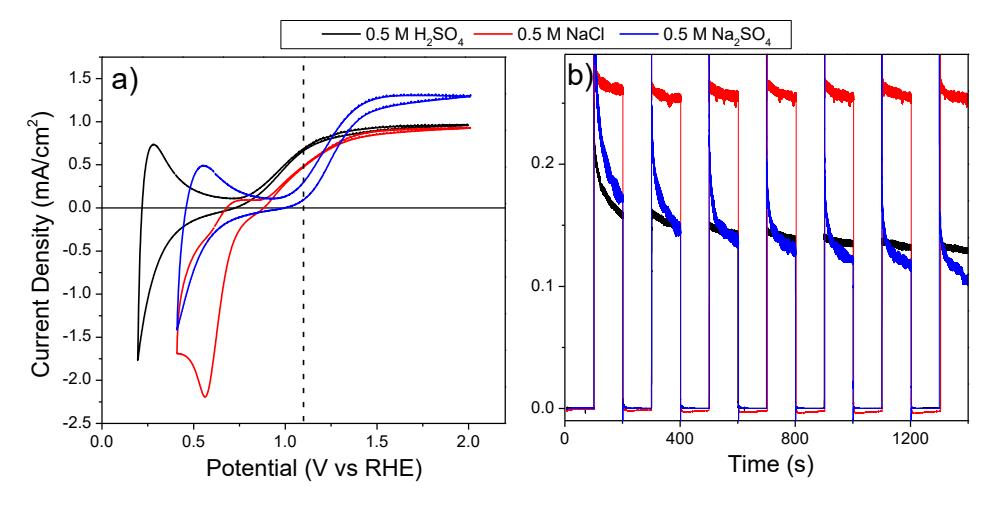
SEM investigations revealed significant differences in morphology of the films prepared using different reductants. The highest PEC activity was observed for the coatings obtained using methanol, isopropanol or butanol. Comparison of photoelectrochemical response of WO3 photoanode prepared using methanol in different electrolytes under potentiodynamic conditions (Fig.1a) shows that highest photocurrent is observed in 0.5 M Na2SO4. However, stationary photocurrent-time profiles (Fig. 1b) obtained at ~ 1.1 V (RHE), i.e. in the E range preceding the photocurrent saturation, where it is limited by photon absorption, revealed that the highest and most stable photocurrent is observed in 0.5 M NaCl solution. This was true for all investigated WO3 samples irrespective of the synthesis conditions and surface morphology. Average FE of PEC generation of hypochlorite and persulfate species was ~73%, ~45% and ~74% in 0.5 M NaCl, 0.5 M H2SO4, and 0.5 M Na2SO4 electrolytes, respectively. The findings of the study imply that photo-oxidation of Cl- ions on WO3 photoelectrodes is the most facile process among the photoanodic reactions studied.