
Metal ions have vital importance for living organisms. Ions plays important role in life cycle of cell starting with reproduction and ending with programmed cell death (apoptosis). Moreover, metal ions are responsible for enzyme production and generally controls all chemical reactions that are happening in living cell. Naturally, high concentration as well as low concentration of metal ions in living organism can have negative impact. One of many metal ions which has both negative and positive effect on living organism is silver ($Ag^+$). Small concentrations of silver ions have antibacterial properties that can kill pathogenic bacteria, however, high concentration can even lead to liver cirrhosis [1]. Other metal ions such as $Zn^{+2}$, $Cu^{+2}$ and $Ca^{+2}$ can accumulate in human body and cause neurodegenerative diseases (e.g. Wilson disease) [2].
Thus, it is important to detect and monitor metal ions in living organisms for that purpose metal ion detectors are being developed. Fluorescence detectors gets a great deal of attention because they exhibit high sensitivity, low production cost and short response time. One of many kinds of organic fluorescence detectors are purin-based organic compounds[3].
In this work we researched photophysical properties of purin-based donor-acceptor molecule, its interaction with different metal ions in different protic solvents. The investigated compound (DaC-60) comprises of 2,6-bis-(1,2,3-triazol-1-yl)purine acceptor and two asymmetrically located 4-methoxyphenyl donors.
The results revealed that in methanol solution organic molecule reacted with $Zn^{+2}$, $Ca^{+2}$, $Ag^+$ ir $Fe^{+2}$ ions producing new fluorescence emission peak at 409 nm wavelength. Similar effect was observed in ethanol, however, only with $Ag^+$ ions. During complexation new peak in fluorescence spectrum with shorter wavelength gradually grows while old one diminishes. Though the exact cause of this shift is debatable, a photoinduced electron transfer between donor branches is supposed [4].
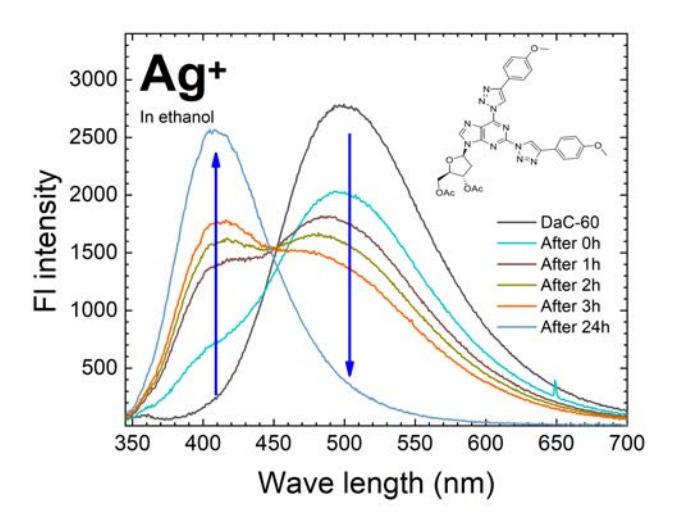
Furthermore, during our research we noticed that complexation was not an immediate process, therefore, time de- pendant measurements (up to 24h after introduction of metal ions) were carried out (Fig. 1). It was shown that the concentration of metal ions and viscosity of solvent plays an important role in complexation suggesting it is a diffusion- induced process.
Overall this compound can be used to detect $Ag^+$ and $Zn^{+2}$ ions in methanol and ethanol solutions.