Thermally activated delayed fluorescence (TADF) compounds have received great attention for their potential to utilize both singlet and triplet excitons in OLEDs formed during charge carrier injection. [1] Rational material design has enabled TADF OLED devices with up to 100% internal quantum efficiencies mainly due to an efficient reverse intersystem crossing (RISC) that allows conversion of dark triplet excitons into emissive singlet states. [2] While RISC is usually a slow process, TADF-OLEDs suffer from early efficiency roll-off associated with high long-lived triplet exciton population. Therefore, TADF emitters with large rISC rate facilitating triplet up-conversion are required. [3]
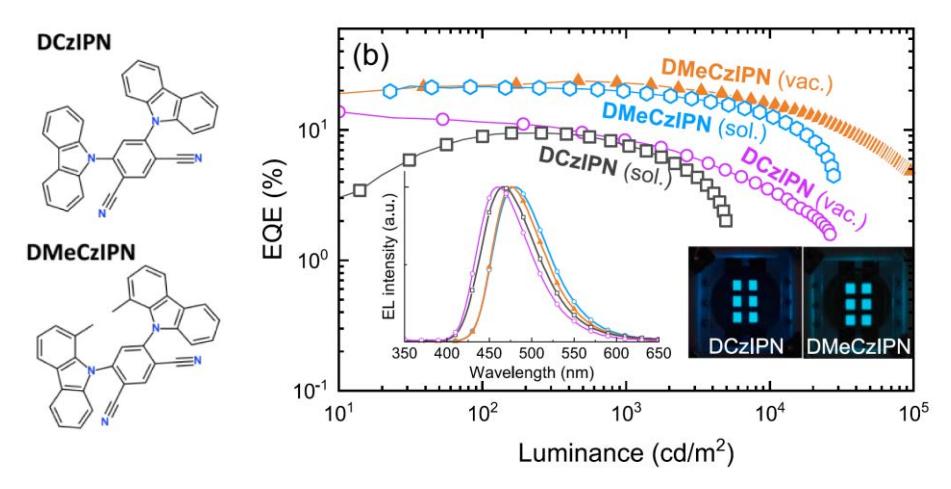
In this work, by introducing a subtle modification to two carbazolyls containing isophthalonitrile-based TADF emitter, we demonstrate a huge impact on its TADF properties. To be more precise, the increased dihedral angle between D and A units is found to significantly reduce $ \Delta E_{st} $, resulting in substantial boost of RISC rate and shortening of TADF lifetime. We fabricated vacuum and solution processed TADF-OLEDs employing 7% isophthalonitrile-doped emissive layer. Devices exhibited blue to sky-blue emission, external quantum efficiency (EQE) of up to 23.8% and high brightness (up to 95000 cd/m2). Most importantly, due to the large rISC rates, TADF OLEDs demonstrated extremely low efficiency roll-off. OLEDs based on modified compound (DMeCzIPN) exhibited significant performance improvement of two times in terms of EQE. Fig. 1 shows chemical structures of unmodified DCzIPN and modified DMeCzIPN compounds and the EQE characteristics of the produced devices together with their electroluminescence (EL) spectra. The obtained results demonstrate the potential of isophthalonitrile-based TADF emitters for high-brightness OLED applications.