
Laser emitters play an important role in modern science; however, large dimensions, complex manufacturing technologies and low efficiency reduces the availability of such devices. Metal halide perovskites are an emerging class of semiconductors holding promising potential in further advancing the laser technology which might overcome these problems with their easy production and small dimensions. However, perovskite materials exhibit high thresholds for amplified spontaneous emission (ASE). More importantly, the ASE spectra peak position highly depends on the composite of perovskite structure, and a research on the influence of different anions and cations in perovskite lattice to the spectroscopic characteristics of ASE is tremendous. In this study, we focus on a lead bromide perovskite family with mixed organic methylammonium and inorganic cesium anions - CsxMA1-xPbBr3 (MA+ = CH3-NH2+). We selectively substitute cesium anion with different molar parts of methylammonium in CsxMA1-xPbBr3 lattice and investigate spectroscopic characteristics of ASE by employing time-resolved photoluminescence (TRPL) spectroscopy.
CSxMA1-xPbBr3 perovskite layers were deposited from a solution on cleaned glass substrates via spin coating method. Molar ratios of cesium and methylammonium in the perovskite solution were mixed in the interval x = [0.25;1] by altering the masses of dry precursors cesium bromide (CsBr) and methylammonium bromide (MABr). These two precursors together with lead bromide (PbBr2) were dissolved in dimethylsufoxide (DMSO). Perovskite layers were passivated with a layer of polymethylmethacrylate (PMMA) polymer from oxygen and water vapor to prevent degradation. By changing the angular velocity of the spin coating process, perovskite layers for an efficient ASE were optimized as thinner and smoother layers were acquired with higher velocities.
Spectral composition of sample emission was thoroughly investigated using time resolved photoluminescence (TRPL) spectroscopy at a different excitation fluence (Fig. 1). At a small optical excitation fluence, a photoluminescence peak starts emerging as a consequence of spontaneous emission in CS0.25MA0.75PbBr3 sample at 530 nm and at 525 nm in single cation CsPbBr3 sample. At a high optical excitation, all perovskite layers demonstrate dual band emission, with additional band emerging at 550 nm in CS0.25MA0.75PbBr3 and at 535 nm in CsPbBr3 layers. We associate additional emission bands with an ASE process, as a growth of intensity of aforementioned band is quadratic. Ultrafast fluorescence decay confirms the nature second photoluminescence band as an ASE. We were able to achieve a satisfactory threshold for ASE below 10 μJ/cm2 of optical excitation fluence. A tendency of amplified spontaneous emission peak shifting toward "greener" (550 nm) wavelengths when the molar part of methylammonium in the perovskite is increased was observed.
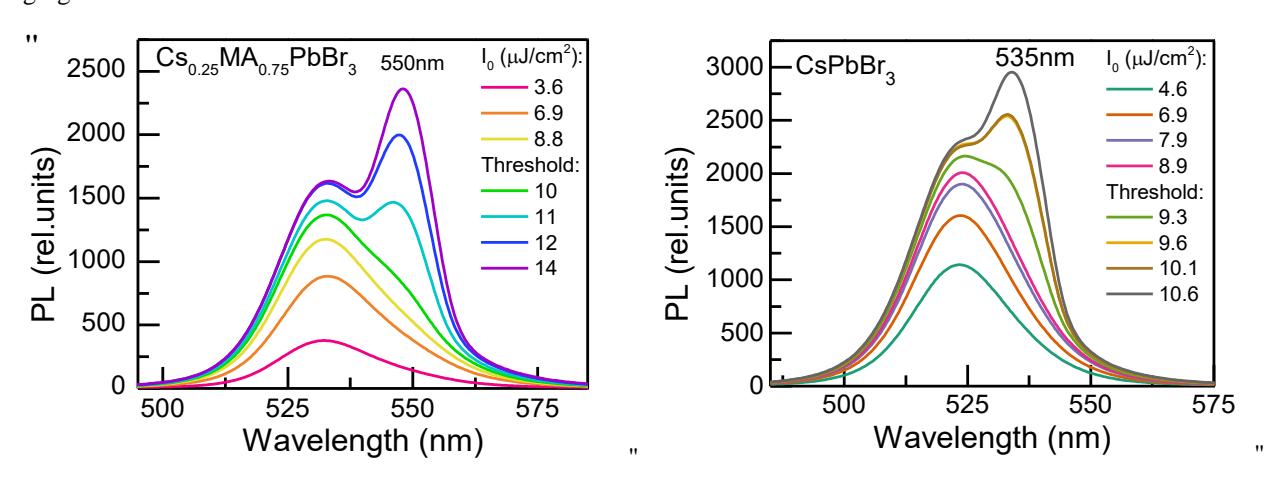
The main results of this study: thinner and smoother perovskite layers obtained with a higher angular velocity of the spin coater are more suitable for efficient stimulated emission generation. Moreover, the spectral position of the peak of amplified spontaneous emission can be easily controlled by changing the composition of CsxMA1-xPbBr3; decreasing molar part of methylammonium leads to amplified spontaneous emission peak shift from 550 nm to 535 nm.