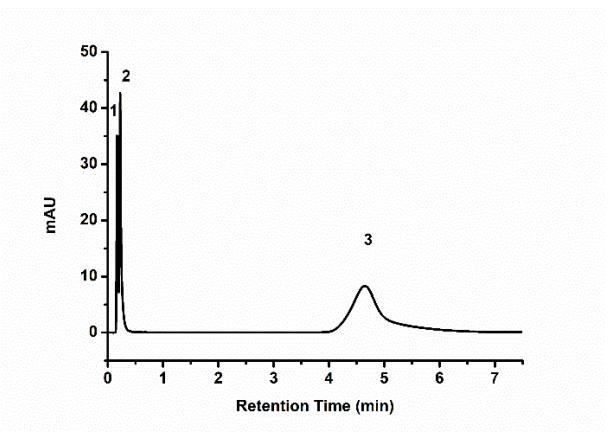
Ion exchange mode high performance liquid chromatography (HPLC) has numerous applications in the pharmaceutical industry. It is used for drug stabilization and used as aids for tablet disintegration. Commercially available polymeric resins ion exchangers exhibit a comparatively high ion-exchange capacity and show a high chemical stability [1]. However, they have many drawbacks, including a swelling nature in organic solvents and a limited pressure stability. While silica-based ion exchangers have many advantages such as a high surface area, a high mechanical strength resulting in high efficiency, and the absence of the swelling problem [2]. However, the silica-based ones possess much lower ion exchange capacity than that of the polymeric resins. Therefore, the surface of the silica was modified via two processes to developed silica based stationary phase coated polymer. In this study, a novel cation exchange stationary phase was designed and synthesized via functionalization of the silica (3 μm, fully porous) by quaternary amino group and coating with Nafion. The material was confirmed and evaluated by elemental analysis, thermogravimetric analysis, Brunauer-Emmet-Teller (BET) analysis, infrared spectroscopy and scanning electron microscopy with Energy Dispersive X-ray detector. The characterizations demonstrated the successful of functionalization of the silica and coating with Nafion. This stationary phase, suitably prepared, exhibited excellent cation exchange separation [3] of N, N, N-trimethyl phenyl ammonium chloride (TMPAC) using HPLC (Fig. 1).