Characterization of the chemical components of atmospheric submicron aerosols is important, because of their adverse human health effects and significant influence on the Earth's climate system. Therefore, it is crucial to deepen the knowledge of aerosols chemical composition and pathways of formation.
Aerosol main chemical components were investigated in Rūgšteliškis (Lithuania) rural environment by operating Aerosol Chemical Speciation Monitor (ACSM). The analysis of 5 years (2013, 2014, 2016, 2018 and 2019) data series was performed for 3 seasons (spring, summer and autumn). Time series and diurnal trends of organic aerosols (OA) and inorganic aerosols (IA) were analysed. OA were exhibiting higher contribution 60-80% to total submicron particular matter (PM1) whereas, IA were showing lower contribution 20-40% (NO3= 3-12%, SO4= 4-20%, NH4= 3-21% and Chl = 0.2-0.4%) over all seasons. During summer of 2013, 2016 and 2018 OA had a higher contribution to PM1 compared to spring and autumn. Meantime in 2014 and 2019 the highest contribution of OA was observed over the spring.
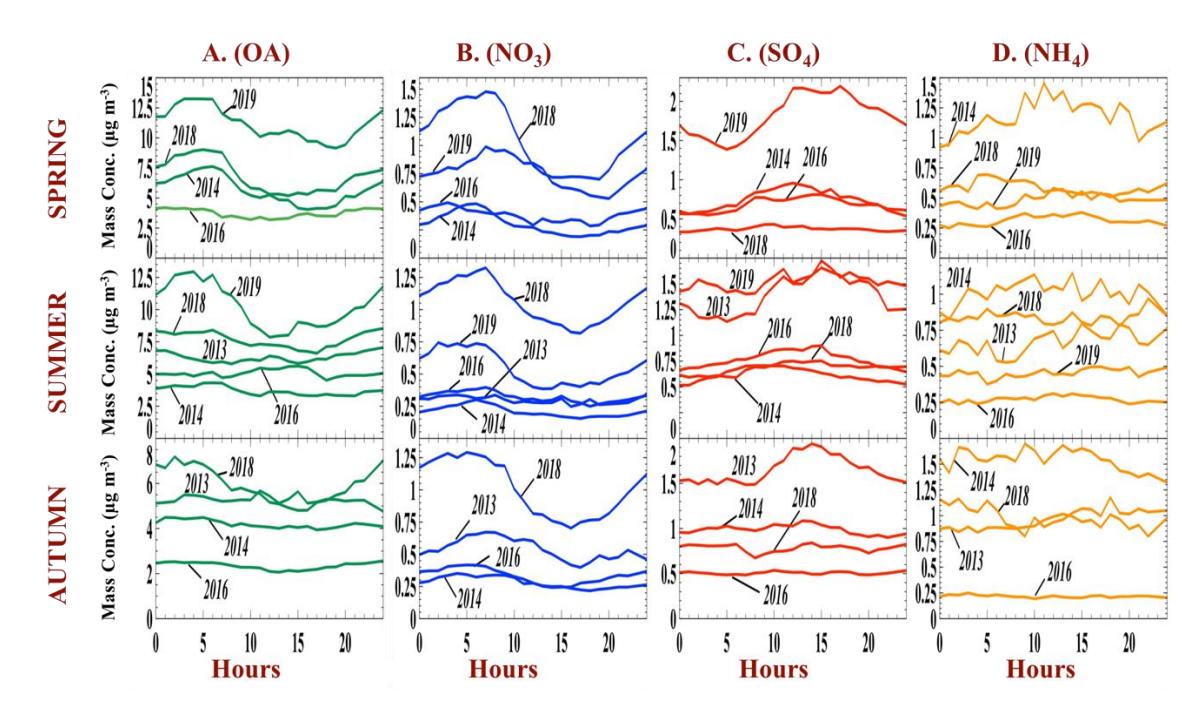
Diurnal trends of OA and IA were assessed in order to characterise possible day and night aerosol chemistry and sources (Fig 1). Higher mass concentration of OA was observed in morning hours (5-7 h) and lower mass concentration during daytime (13-19 h) (Fig 1A). Similar trend was observed for NO3 mass concentration, which reached maximum between 5-7 h and minimum between 15-20 h (Fig 1B). This diurnal pattern could indicate nocturnal chemistry. SO4 and NH4 had lower mass concentration during daytime (10-19 h and 13-23 h, respectively) and higher mass concentration during night time (1-6 h and 1-10 h, respectively) (Fig 1C, D). Formation of SO4 aerosol was possibly carried out during day time by the oxidation of gaseous precursor SO2 followed by particle formation through nucleation and condensation processes. Therefore, significantly higher SO4 concentration was observed during the daytime. Neutralization of HNO3 and H2SO4 with NH3 likely formed ammonium derived aerosol in the form of NH4NO3 and (NH4)2SO4 [1]. In addition, submicron aerosol particles acidity (H+Aer) and stoichiometric neutralization ratio were calculated and analysed [2]. The results of this study could provide a better understanding regarding atmospheric chemistry on local and global scale.