
Betulinic acid is one of the most studied compounds from the class of pentacyclic triterpenoids with high biological activity. Betulinic acid has an antiproliferative and proapoptotic effects on malignant cells, therefore, it is under consideration as a basis for highly active antitumor agents. However, low solubility and poor bioavailability negatively affect clinical efficacy and limit the use of such compounds, that is why it needs to develop strategies for delivery to cells such chemicals. A promising approach to solve this problem is conjugation of these compounds with nanocarriers [1, 2]. Based on this, it is of interest to study the effect of biologically active compounds in the composition of nanoparticles on the interaction of the resulting hybrid nanostructures with cells.
The aim of this work was to study the process of binding of QDs – betulinic acid conjugates to tumor cells and to determine how this compound in the QDs' shell affects interaction with cells. For this experiment we used fluorescent semiconductor nanoparticles (quantum dots – QDs) and QDs conjugated with betulinic acid derivative.
Experiments were carried out with CdSe/ZnS core-shell QDs encapsulated with an amphiphilic polymer based on poly(maleic anhydride). The polymer charge was tuned by introducing a controlled amount of quaternary ammonium groups into the polymer. Weakly positive and strongly positive charge of the QDs inverstigated was chosen based on our previous studies [3]. Bethulinic acid was conjugated to polymeric shell of QDs by standard carbodiimide protocol. The conjugates were characterized by ${\zeta}$-potential of +9 and +20 mV. Reference QDs (without biomolecules in the shell) had ${\zeta}$-potential +4 and +15 mV, respectively. The hydrodynamic size of all particles was in the range from 15 to 22 nm; thus, the size effect between the reference QDs and the conjugates was not considered.
The results from flow cytometry shows that the QDs – betulinic acid conjugates of +9 mV ${\zeta}$-potential (QDs_Bet1) bind to cells better than the reference ones (+4 mV, QDs1). The study of QDs – betulinic acid conjugates of +20 mV ${\zeta}$-potential revealed the opposite effect such that the reference QDs bind to cells more effective than ones with bethulinic acid in the shell.
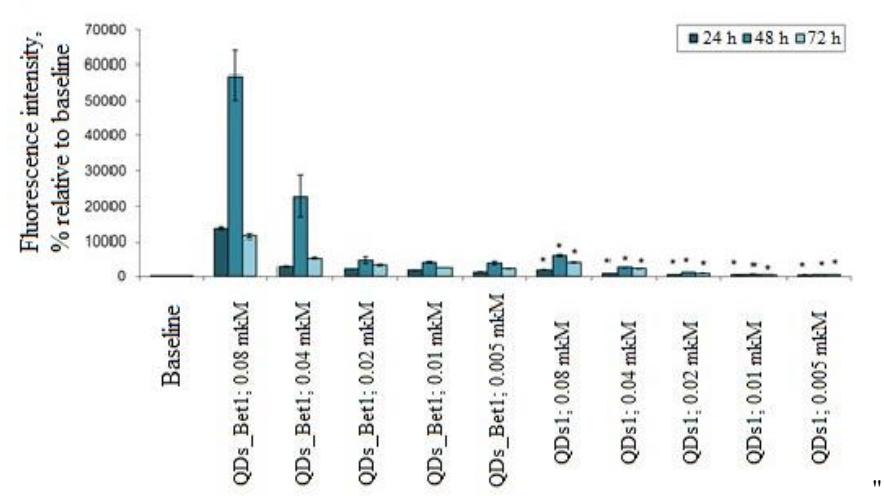
The conjugation of QDs with betulinic acid derivative changes the intensity of the interaction of nanoparticles with cells. The direction of changes in the interaction “nanoparticle – cell” depends on the value of surface charge of QDs: conjugates with ${\zeta}$-potential close to neutral bind to cells more intensively, and conjugates with a high positive ${\zeta}$-potential less intensely than the initial nanoparticles. The extent of the observed effects depends on the concentration of nanoparticles.