
Hydrogen trioxide (HOOOH) molecule plays an important role in different atmospheric phenomena [1-3] as well as in functioning of biological systems [4,5]. However, the establishment of its spectral and structural characteristics is largely hampered by the ability of this molecule to form associates. To date, practically nothing is known about the spectral and structural characteristics of clusters of the hydrogen trioxide molecule, including its simplest associate, a dimer. Therefore, we made efforts to search for the conformational diversity of dimers of hydrogen trioxide molecules, as well as their spectral characteristics. We optimized the geometry of the dimers starting from different initial points using B3LYP/cc-pVTZ level of theory. At least four equilibrium geometries of the dimers were found. The configurations of three of the found conformers belong to the point symmetry groups C2, Ci, and Cs. The fourth conformer is characterized by the absence of symmetry elements. We will denote the corresponding conformers of the hydrogen trioxide molecule dimer as follows: D2, Di, Ds and D1. Equilibrium configurations of these conformers are represented on Fig.1,2.
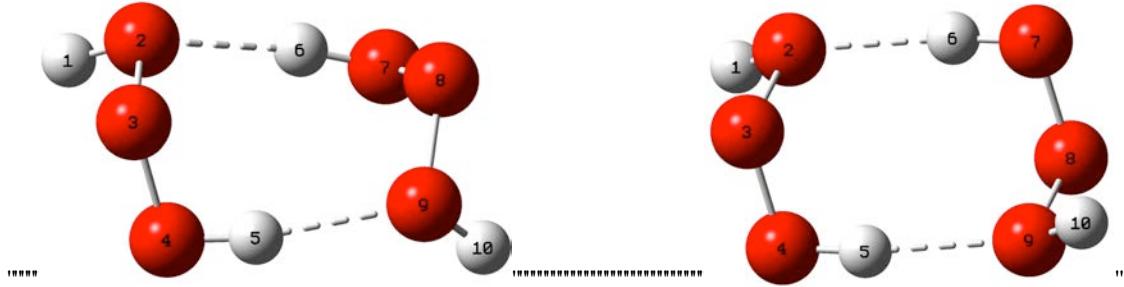
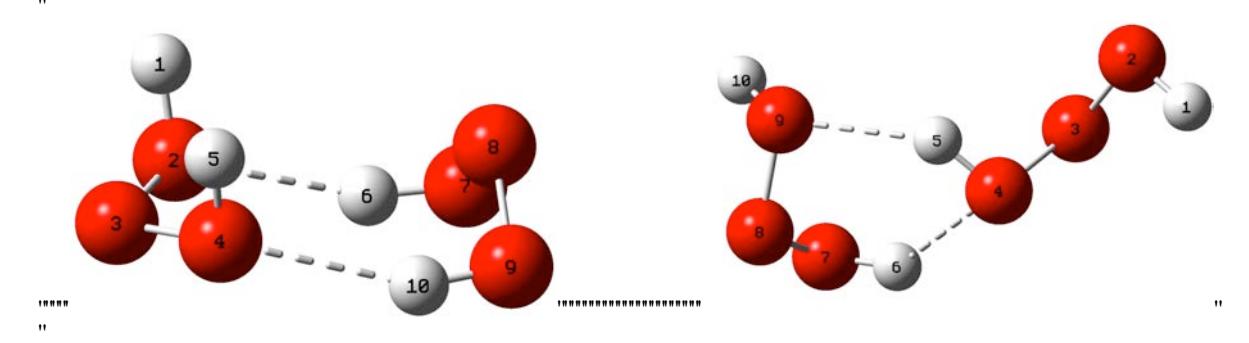
As one can see the conformers D2, Di and D1 are "made" from trans- conformers of the hydrogen trioxide molecules. The conformer Ds is "made" from cis- conformers of the hydrogen trioxide molecules. All conformers form a double hydrogen bond. It is known that the trans-conformer of the hydrogen trioxide molecule is energetically preferable to the cis-conformer [6]. Presumably, due to this fact, conformer Ds turnes out to be energetically least preferable in comparison with other conformers. The D1 conformer has the lowest energy. IR spectra of all conformers were calculated at B3LYP/cc-pVTZ level of theory in harmonic and anharmonic approximations.