
Histidine is an amino acid with a unique structure that allows it to take part in various molecular interactions. The focus is on the side chain of histidine – the imidazole ring, which coordinates many metal ions. Because histidine interacts in multiple ways with other amino acids and metal ions [1], further research is required to better understand the role of histidine in protein interactions.
One of the most informative and non-destructive methods used to determine the structure and properties of materials on a molecular scale is surface-enhanced Raman spectroscopy (SERS) [2]. Unfortunately, the method has some downsides – only a small number of metals are SERS active, and a metal substrate must be nanostructured, which renders the method useless for systems on smooth surfaces. In 2010 a new method of enhancing Raman signal was introduced, which suggested using Au or Ag nanoparticles with a thin inert shell [3]. The method of shell-isolated nanoparticle-enhanced Raman spectroscopy (SHINERS) suitable with any substrate, and the thin shell does not allow the SERS-active cores to interact with each other and with the probed molecules.
The main aim of this study was to identify the molecular structure of the self-assembled monolayer (SAM) formed from N-(2-(1H-imidazol-4-yl)ethyl)-6-mercaptohexanamide (IMHA) in an aqueous solution applying SERS and SHINERS methods. For the SERS method, the SAM was adsorbed on a roughened Au electrode, while for the SHINERS method on a smooth Au electrode. Moreover, SHINERS method employing Ag@SiO2 nanoparticles.
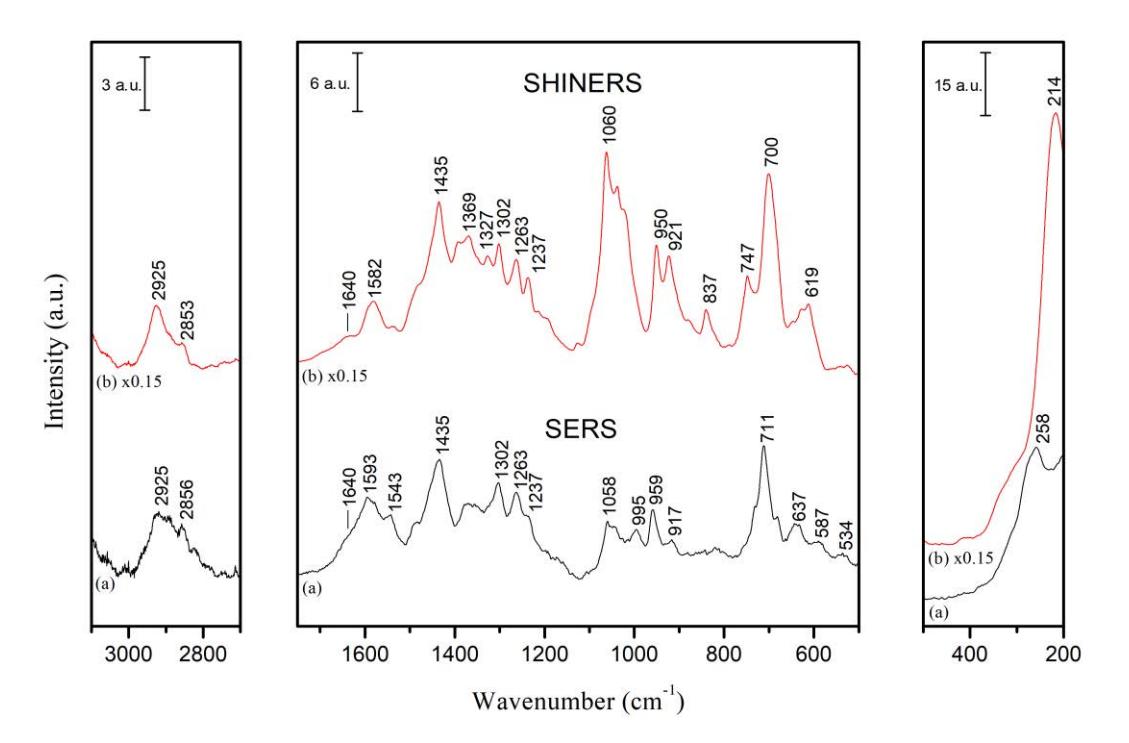
During this study, it was found that the symmetric stretching vibration of methylene groups is at slightly lower wavenumbers in the SHINERS spectrum (2853 cm-1) compared with the SERS spectrum. This result is remarkably related to a higher level of ordering for SAM prepared on smooth Au substrate.